
Julia Frankling –
Repeated power outages during the early July heatwave left residents of a Toronto Community Housing apartment building in Moss Park without air conditioning and reliable elevator service. Some tenants lost the use of essential medical equipment, prompting calls for greater accountability and investment in aging infrastructure.
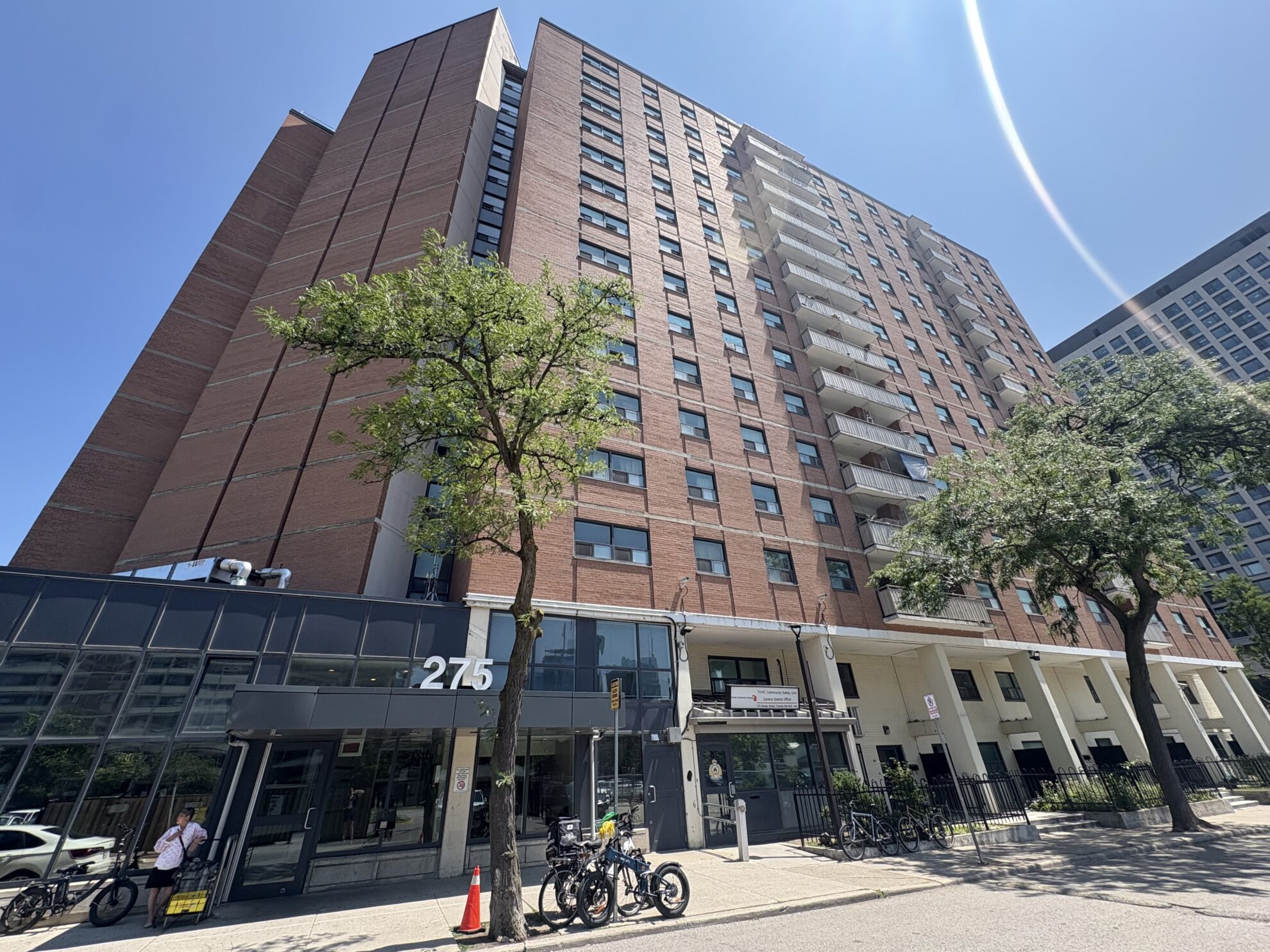
Residents of 275 Shuter St. say intermittent outages began on July 1, when temperatures reached 35 degrees Celsius (not factoring in the humidex). Initially affecting part of the building, outages expanded to the entire building two days later.
Power was restored after TCHC replaced a circuit breaker, but failed again on July 9, resulting in another building-wide outage. After that, Toronto Hydro supplied generators to temporarily operate the building’s elevators.
Brief outages aren’t uncommon when extreme temperatures strain power grids, particularly in high-density areas with air conditioning units, but residents say the prolonged disruptions created dangerous conditions, especially for seniors and people with disabilities.
Mohamed Yusuf says the outages forced his elderly uncle, Mohamoude Yahyah to go to a hospital. “He uses the CPAP machine and breathing machine, and he couldn’t breathe when the power went out. He has to use oxygen all the time. He had to go down the stairs – and he can’t even walk, he has to use a walker – to plug it in and use the machine outside the building, then walk up seven flights of stairs. It’s very tough for him, he’s in his 70s.
“Sometimes the elevator was working, sometimes it was not. Sometimes it would be half a day, then out at 9 or 10 at night and come back in the morning. After three or four days of not using his CPAP and breathing machine regularly, he needed to go to the hospital.”
TCHC said a broken circuit breaker caused the initial outage on July 1, affecting the south side of the building. According to the agency, a replacement breaker had to be sourced from outside Ontario, before being installed on July 3.
“We understand power outages of any kind are frustrating, and we deeply appreciate the patience tenants showed while we worked to resolve this matter,” said Kimberly Moser, TCHC’s manager of external communications.
TCHC said emergency generators kept elevators, lighting and power available in common areas, including a cooling room, with available power outlets, while staff remained onsite to assist residents throughout the outage. After the repair, tenants should not expect a repeat of outage, it said.
Ahsen Bhatti, a member of the Moss Park Coalition, said he contacted Toronto Hydro, TCHC and city Councillor Chris Moise’s office soon after the outages began, but struggled to get clear information about when services would be restored.
“When the outage was throughout the whole building, the two elevators were non-operational and the AC units were not working. Luckily, July 9th was not as warm as previous days, but I did hear that one resident had to go to the hospital due to heat exhaustion when the power first went out at the beginning of the month. Another resident fell down in the stairwell due to the elevators not being operational,” Bhatti said.
In addition to the air conditioning and elevators being affected, many people were unable to cook, and those working from home couldn’t access the Internet. Lack of lighting was also an issue.
Resident Eric Castonguay said he injured himself while navigating in his dark apartment.
“I fell and hit my elbow while protecting my head during a power outage and had to go to the doctor and have it bandaged. Without the power only the hallway and elevators are hooked up to the generators, and sometimes the plugs in the hallway don’t work.”
“Residents are worried it’ll happen again and are concerned about how it seems like there’s very little support for them when situations like these arise,” Bhatti said.
Toronto Hydro spokesperson Brie Davis said crews responded to the building on both July 3 and July 9 after blown fuses interrupted service.
“We know how difficult it can be to be without power, particularly during periods of extreme heat, and thank everyone for their patience through the restoration process.”
The outages have also renewed questions about Toronto Community Housing’s aging infrastructure. According to the City of Toronto Auditor General’s report, TCHC’s 2025-2034 capital plan identifies $2.3 billion for state of good repair projects, while the agency estimates double the amount is needed in repairs over the same period.
Although an emergency repair, such a broken breaker, would be classified as an on-demand budget item rather than funded through the state of good repair budget, it highlights the importance of ongoing maintenance and emergency preparedness by both TCHC and Toronto Hydro.
Toronto Centre MPP Kristyn Wong-Tam said the outages underscore the need for investment.
“This shows the urgent need for the province to properly fund the capital repair backlog in Toronto Community Housing. Tenants deserve access to heat, cooling, electricity and running water. TCHC must ensure their tenants are always kept safe.”
The building at 275 Shuter Street, like several other TCHC buildings in Moss Park, was constructed in the 1960s. Residents say preventing another prolonged outage will require more than temporary repairs. They also call for clearer emergency communication, long-term infrastructure upgrades and assurances that essential services will remain available.