

Andre Bermon –
Conditions are worsening at the intersection of Dundas and Sherbourne Streets.
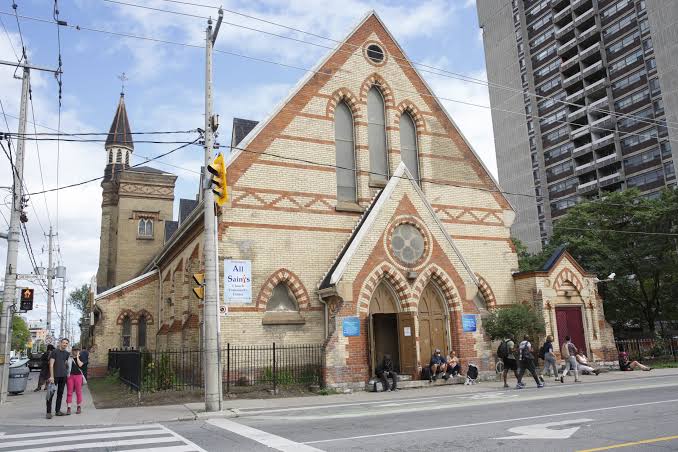
All Saints Church, on the south-east corner, is inundated with homeless people, many suffering extreme drug addiction. On any given day, people lie against the church building, some incapacitated, stretching onto the sidewalk.
Dealers pushing hard drugs run amok, while encampments, litter and abandoned furniture dot the surrounding streets and laneways. Local residents describe scenes of open sex and masturbation, loud music at night, violence and even murder. Police efforts barely monitor the deteriorating community.
All Saints, a beacon of hope for Toronto’s down and out, recently lost its drop-in program partner, Margaret’s Housing and Community Support Services. After nearly a decade of operation inside the church, the charity was forced to vacate due to structural problems with the building.
“The program has closed,” Ward 13 Councillor Chris Moise said in email statement to the bridge.
In its place, Margaret’s Community Engagement Team of social workers is providing outreach services to people in need. However, that operation will cease at the end of September.
Margaret’s had searched for an alternative site nearby but was unsuccessful.
Moise says leftover funding is being transferred to nearby organizations including Fred Victor, at Queen and Jarvis Streets, and the Regent Park Community Health Centre. The latter runs a provincial HART Hub, a homeless and addiction recovery centre replacing its former safe injection site, which closed in March.
For years, Cabbagetown South residents blamed All Saints and Margaret’s for tolerating antisocial behaviour and illicit drug dealing. Before its closure, local residents met monthly with organizers of the church and Margaret’s to hash out complaints.
James McKay, who attended meetings for the Cabbagetown South Residents Association, told the bridge that frequent complaints about loitering and overflowing garbage bins, often attracting vermin, were never addressed.
“They couldn’t control the people inside their building or outside their building and had no meaningful process to ensure the well-being and safety of their staff, their clients or the wider community,” said McKay.
The church’s board of directors rejected a proposal to get All Saints to comply with a trespass order from Toronto Police to deter unwanted behavior on its property.
Stan Cuomo, another resident who attended the meetings, said All Saints refusal to sign the trespass letter was in bad faith. “They’re not being a good neighbour if they’re not cooperating with the police.”
Many in the community are happy to see Margaret’s go, but its closure brings little immediate relief. Since the provincial government shuttered safe injection sites, residents told the bridge they have seen more drug activity.
Hayley Blackmore, a mother of two, says “things have gone from bad to worse…If you walk down the [adjacent] alleyway at any time of the day, there could be people having open sex or consuming illegal drugs or in a deep state of psychosis.”
To access their garage, the family must use the laneway, meaning Blackmore warns her children before letting them through. She says they are repeatedly exposed to drug use, mental health crises and other disturbing behaviour.
Not all people who are homeless are aggressive or unsafe, Blackmore points out. A few have spoken to her openly about their drug addiction. “You know, that’s their life. That’s really sad.”
Across the street from All Saints, the Street Health overdose prevention site is on the front lines of Toronto’s drug crisis.
Christina Van Sickle, the new executive director replacing Lin Sallay, has decades of experience as a social worker and is “very familiar” with the Dundas Sherbourne area.
The major challenges in the community are the loss of affordable market housing due to condo development and the increasing toxicity in the drug supply, she says. The closure of safe injection sites is putting pressure on her team to respond to drug users in nearby streets and alleyways.
To help accommodate the rise in demand, Street Health extended its hours of operation to 8 p.m., on weekdays. Clients are encouraged to snort, inject or digest drugs already in their possession inside the facility, where staff can monitor their condition.
In response to community concerns about security, Van Sickle said a new company has been on site since May 19 to oversee clients and staff from noon to close every day.
If residents have complaints, Van Sickle welcomes them to contact Street Health. “One of my large priorities as executive director is to further enhance communication and relationships with community members.”
She hopes locals will join Street Health’s citizens advisory committee, which meets quarterly (visit streethealth.ca/contact). The next meeting is scheduled for September.


1 Comment
We suspected that the end was coming, but reading of it in a newspaper was remarkable.