
Mike Mastromatteo –
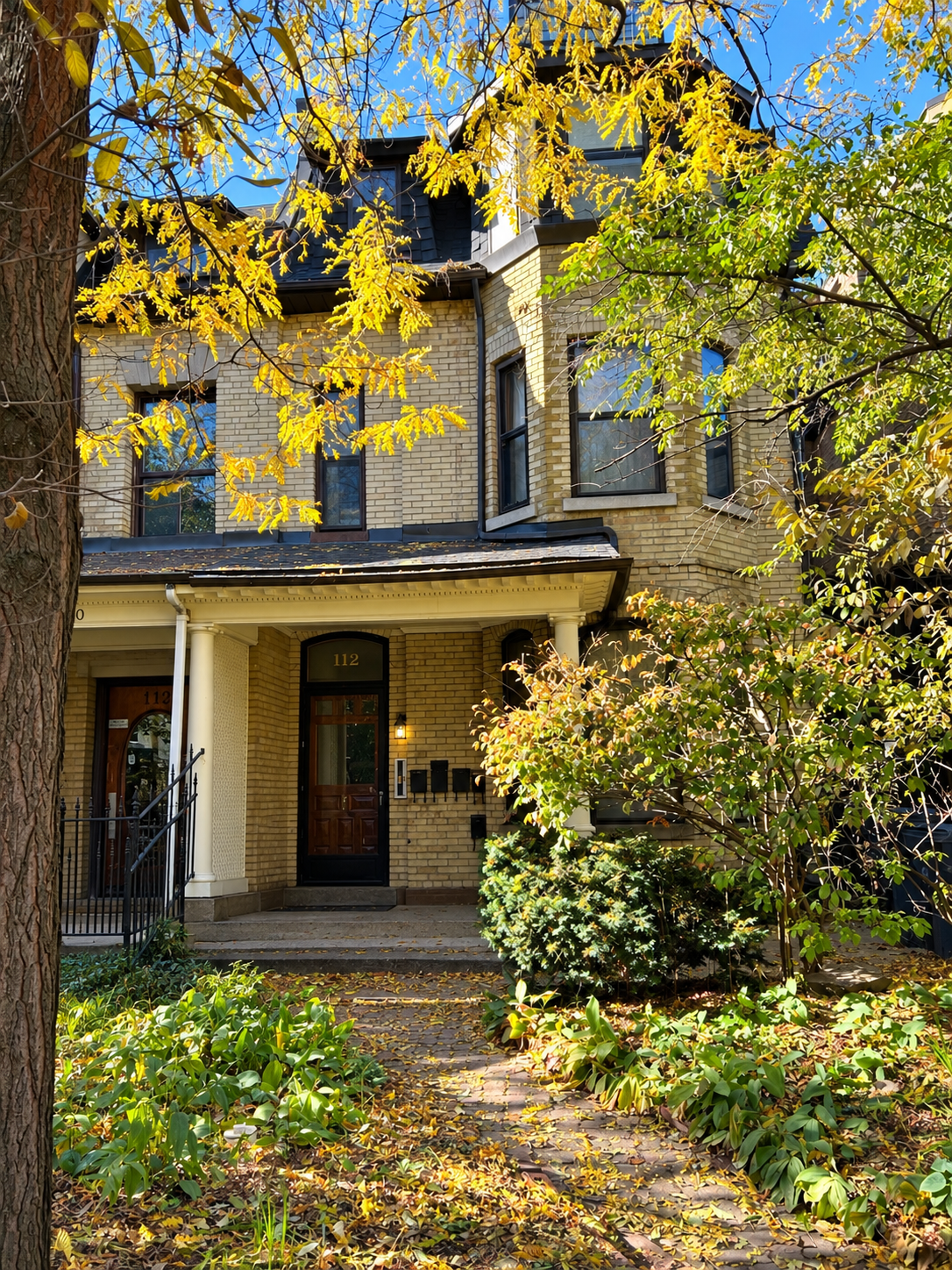
112 Pembroke Street
The boxy, semi-detached building at 112 Pembroke Street in Cabbagetown is classified as a “vernacular” house-form building. While the word vernacular is usually associated with language, architects use the term to describe local, traditional buildings designed by everyday people using nearby materials.
But if 112 Pembroke and neighbouring houses might not appeal to architectural elitists, these houses represent the more mundane aspirations of Victorian-era homeowners: practicality and pragmatism. These houses aren’t grandiose, but reflect the tastes of people who had achieved a degree of stability and respectability, but weren’t wealthy enough to indulge in architectural extravagance.
Cabbagetown’s unofficial poet laureate, Barbara Mercer, might have had 112 Pembroke and other such houses in mind when she penned her poem “Phantom Mirror.” A fragment of the poem reads:
Phantom mirror
Has witnessed much – we know little
Previous houses
Of grandeur
Social intercourse
For better – or worse
Lives lived – in dark Victorian homes
Where decisions must be made
To stay or leave – laughter – tears
…
Past – present – heartbeats
Will you repeat – what you’ve seen?
Will you reveal the future?
The first owner/occupant of 112 Pembroke was John H. Davis, a veteran postal employee who lived in the home from 1878 until the closing years of the 19th century.
After Davis died, his wife Fanny occupied the home until about 1921. A November 23, 1923, item in The Globe newspaper item noted the passing of Fanny Davis, widow of John.
John and Fanny had a son, Clarence, whose life and work seem to have escaped notice in directories, newspapers and other standard forms of record keeping.
Next came the Paterson family: Archibald, wife Florence and son Archie, who lived at 112 Pembroke for the next 22 years. Archibald Paterson was first identified as a painter, but later added decorator to his CV. While he was a curling aficionado with the Royal Canadian Curling Society, Paterson left no easily discoverable record of his painting and décor work.
Nonetheless, his son Archie (born 1918), added to the family lore by participating in a contest sponsored by the Ontario Safety League. The December 20, 1930, Globe records Archie winning a $3 prize in a student contest focusing on best practices in pedestrian and travelling safety on downtown streets.
Archibald Paterson’s death on December 24, 1945, at age 59 brought tributes from military officials who noted his service in the 18th Battalion during the First World War. Although spending the bulk of his adult life in Cabbagetown, Archibald hailed originally from southwestern Ontario. The battalion, part of the wider Canadian Expeditionary Force, was formed in London, Ontario, and consisted largely of farmers and small-town folk. The 1911 census featured Archibald Paterson, then living in London, as a farmer.
After the Patersons, Harry Westbrook and family occupied the Pembroke Street home. Westbrook was a long-time employee of Canadian National Railways (CNR). A native of Kent, England, Westbrook arrived in Canada in 1902 and made his way to Toronto in 1927 after a brief stopover in Lindsay, Ontario.
Harry passed away in 1953, and his wife Grace resided at the Pembroke home until the mid-1950s. As was common with many older homes in Toronto, the home slowly succumbed to the rooming house “malaise” in which the main structure was subdivided into smaller apartment units.
TTC employee George Rutherford resided at the home in 1958, followed by Angus Goodwin, who lived there until the mid-1960s. Curiously, a Donald Goodwin, another TTC operator, resided next door at 110 Pembroke from 1954 until the early 1960s.
In October of 1958, a letter to the editor of the Toronto Daily Star bemoaned plans by Toronto city councillors to construct a new $18 million city hall. It was the opening round of debate that eventually led to the building in 1965 of the current Toronto City Hall.
Henry R. Brennan, a lodger at 112 Pembroke, suggested the money could be better spent. “What kind of parents are these city fathers who would spend $18 million plus for a home for themselves…while thousands of their children dwell in slums? It is no more commendable than parents getting drunk in beer parlours with hungry and neglected children at home.”
Brennan had worked as a sailor and farmer before finding work as a pipe fitter with the Canadian Pacific Railway in the early 1960s. Active with the Toronto and District Trades and Labour Council, he ran unsuccessfully for the provincial parliament in 1963 for the New Democratic Party. He was also a candidate for Toronto City Council in York West, but was not elected.