
Julia Frankling –
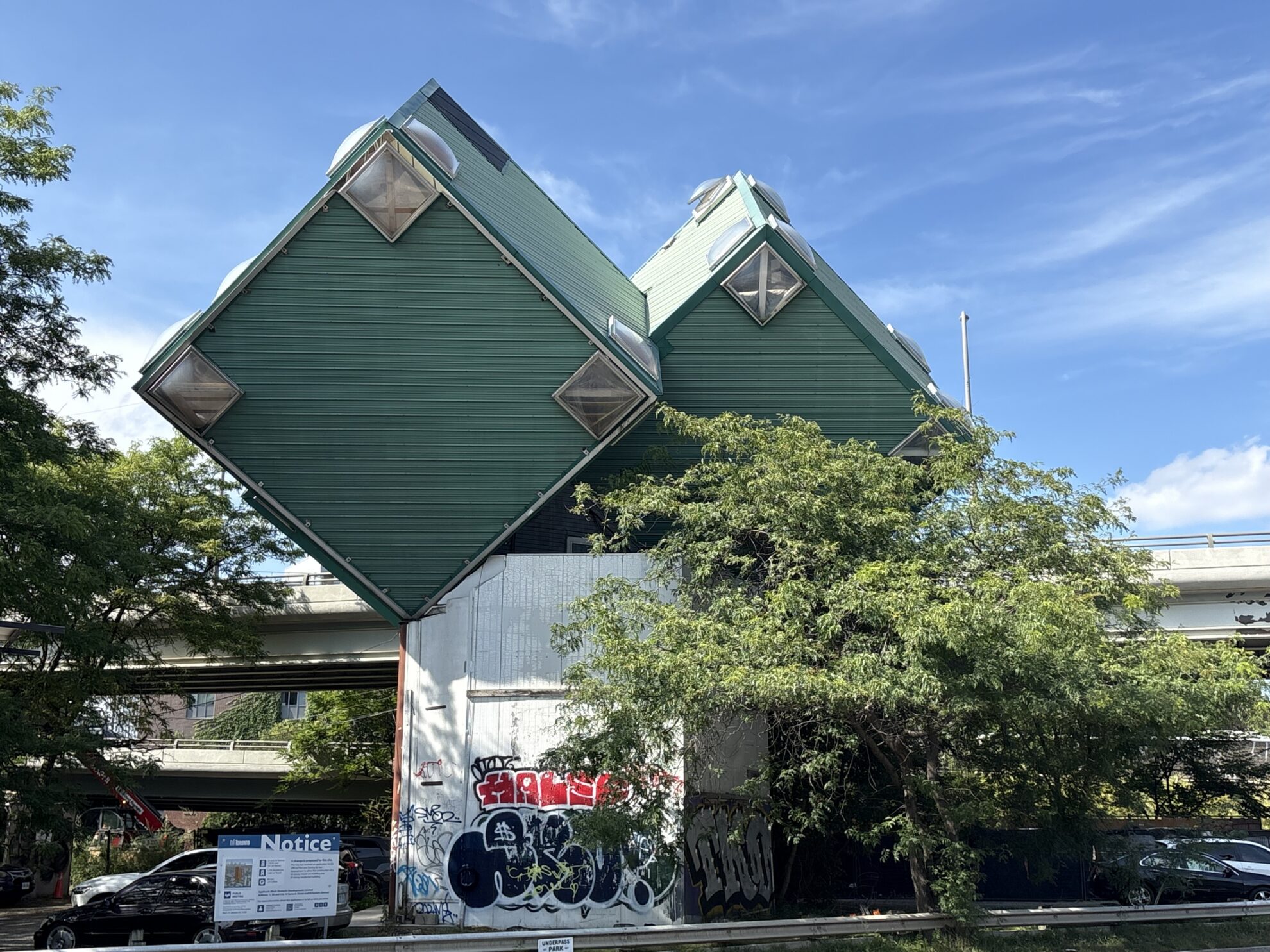
Toronto’s iconic green cube houses beside the Adelaide Street East overpass are expected to come down soon after City Council approved two high-rises, of 57 and 59 storeys, at its June 26 meeting.
The decision follows May 28 approval by the Toronto and East York Community Council of a Block Developments’ plan to build on the site at 1, 2A-16 Sumach Street and 90 Eastern Avenue.
The cube houses were erected in 1996, becoming a unique Corktown example of experimental architecture.
In its 30 years the building has served multiple purposes, including as a private residence, a Coffeetime billboard and a recording space for musicians.
The bridge’s columnist Christopher Hume wrote about the cubes for the Toronto Star in January 1996: “Whether or not these modules mark the arrival of the future remains to be seen, but they indicate a radical departure with the past.”
Toronto heritage staff say the owner agreed that “the property has heritage value sufficient to warrant commemoration. The applicant has retained an artist who will develop a commemorative installation” using reclaimed materials from the cube house.
Block Developments told the bridge that this art installation, by multidisciplinary environmental artist Benjamin Von Wong, could be placed in the adjacent underpass parkette, currently under construction.
Von Wong told the bridge, “Since the Cube House is such a landmark in Corktown – my hope is to honour its legacy and find a way of transforming the building’s old materials into a new piece of public art. We’re still in the research phase and would really love to hear more from the community before we even start exploring what kind of art should be created! If you have a story, I’d love to hear it!”
But the ownership of the cubes – and their fate – remains disputed.
Ben Kutner, who built the structures alongside his partner Jeff Brown in 1996, says he is their rightful owner and that neither the city nor the developers have the right to dismantle or alter them.
Kutner told the bridge “The land was flipped many times since 1986 by real estate developers who speculate on increased land value by density and high-rises. Block does not own the UniTri cube houses and never did, as the previous landowner did not have title to the personal property. Block does not have any rights to authorize anyone, and the artist does not have rights to do anything”
As the bridge reported last December, Block Developments purchased the land surrounding the cube houses in 2021 for $19 million, along with residential and commercial plots across the street.
The cubes are considered chattel, (moveable personal property that is not included in a property’s title.)
But Toronto Heritage staff said neither the owner nor the city could find a reasonable way to retain or relocate them.
Olivier Sabino, a former resident of 2 Sumach Street, was sad the buildings were deteriorating but was pleased to hear that facades of neighbouring heritage buildings will be incorporated into the west tower and that a commemoration is planned for the cubes.
“There’s nothing else like it in Toronto. It’s important to preserve something unique aesthetically.”
Julia Cavalaris, who went to school in the area, said she believes the redevelopment reflects a larger loss to Toronto’s character. “Growing up taking the Bayview extension to school with my mom, she would drop me off right beside those cubes and I would look up and wonder what they were ever even used for – and that’s kind of their magic.”
Cavalaris said the cubes could be used for a community space or for art installations.
“I don’t understand why Toronto is so dead set on taking anything that has ever made this city unique and turning it into condos? It just feels like a city without a soul.”
Kutner and his company UniTri Technologies created the cube houses, as a modular housing prototype inspired by Dutch architect Piet Blom’s famous 1984 Kubuswoningen or Cubic Houses.
The structures were originally conceived to each represent a tree, forming a forest or small village when grouped together.
Now living in Ottawa, Kutner argues the technology could offer an alternative solution to Toronto’s housing crisis. He says they are less expensive, adaptable to awkwardly shaped lots, contaminated land or flood-prone areas. “A 1000 square-foot cube, delivered and installed in a day would cost $400,000, 50% of a comparable condo on the market.”
The project was intended to be much larger.
“The original plan was and still is to relocate the structure across the overpass, and to build hundreds more,” said Kutner.
The UniTri cubes were intended to be shipped and sold from Toronto as a full-scale plein-air prototype. “The key issue that all the lawyers got wrong, is that the UniTri cubes are defined under the copyright act as an architectural work.”
Kutner is still open to working with Block if the city facilitates and said he requested the cubes be relocated in 2027. “Staff told us to write to Mayor Chow, which we did and were ignored.”
The approved development does not include subsidized or affordable housing units. But Block told the bridge it will take the community’s feedback into account and likely put a grocery store in the ground floor retail space.
The flatiron design and material selection for the project “were chosen to better fit with the area than a traditional window wall tower would.”
Street-facing portions of the neighbouring heritage houses at 6-12 Sumach Street, built between 1886 and 1889, will be incorporated into two-storey podiums at the west tower at a new location on Old Sumach St.
Concerns in the community include whether the Corktown infrastructure can support the project’s additional density, and that it could set a precedent.
Daniel Tate, a candidate running to be Ward 13’s city councillor, called the proposal “a monstrosity of density. Nothing (in the area) exceeds 20 stories max.”
Martin Trainor, the longtime and now sole resident of the cube houses, worries about what will happen to the memory of the cubes. “Nobody has gotten back to me on when I’m due to be evicted,” he said at the community council.
The timeline of the project remains unclear. Block Developments said the project will require about $250 million in construction spending and generate approximately 1,925 jobs and years of employment across construction, supply, and long-term site operations. “We will be prioritizing the use of Canadian-manufactured materials.”