
Christopher Hume –
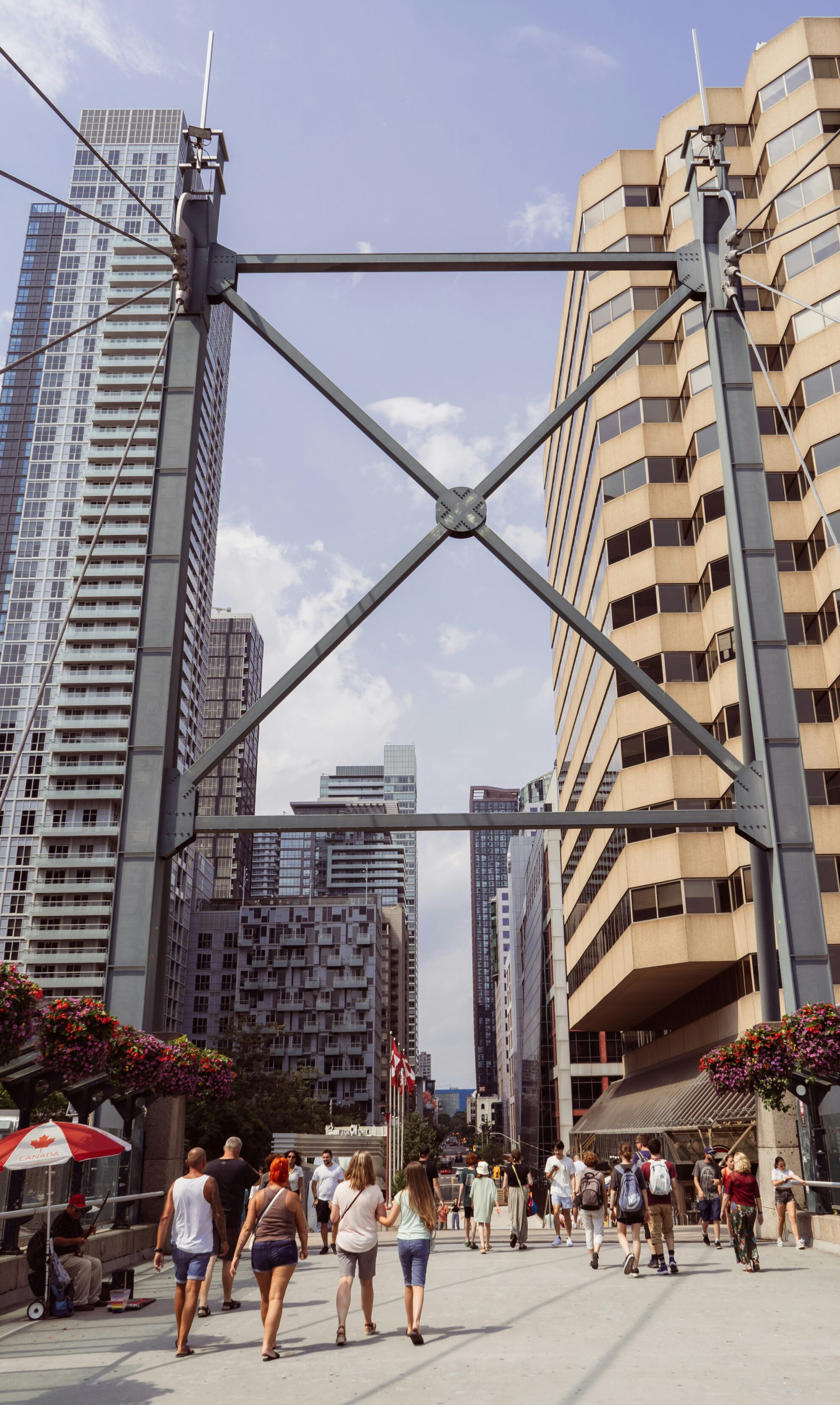
They’re back! Tourists, of course. Instantly recognizable, they can be seen with their backpacks, baseball caps and shorts, wandering aimlessly yet intently throughout the downtown core. Most are Americans, but they arrive from all over the world: China, Japan, the U.K., France, Germany…. Torontonians can’t help but wonder why they choose to come here, but come they do, and in surprisingly large numbers.
In the global imagination, Canada is the Great White North, a place of pure uninterrupted nature. It’s not hard to understand why: think of the Rockies, Tofino, Algonquin Park, Gros Morne in Newfoundland…. the list is endless.
Despite what these visitors believe, Canadians are actually a thoroughly urban, or more properly, suburban, people. The notion that we are a nation defined by geography has gone the way of the transcontinental railroad.
In Toronto, nature exists at a distance. And in a time of climate change, it has increasingly become the enemy. No matter. Tourists who come to this city are looking for a big city experience, skyscrapers, the thrill of high-rise urbanism and the charm of a low-rise historic centre. Locals know better but hope, let alone misinformation, springs eternal. One excited visitor from the United States enthused in a CBC radio interview about the amazing architecture she saw driving downtown from Pearson Airport. Really!
For the rest of us, nothing is more dispiriting than trekking along the Queen Elizabeth Way or Highway 401. Both routes reveal everything wrong about the North American approach to the city and, let’s not forget, this continent’s abject dependence on the automobile.
As for our version of the historic centres eagerly sought out by North American tourists in Europe, Toronto has done a pretty good job of obliterating any vestige of what without irony it still calls “Old Town.”
Thankfully, there’s little danger of Toronto suffering the industrial-scale tourism that blights many European cities. Though figures vary wildly, Paris is said to have attracted 50 million “international visitors” in 2024. London got more than 20 million. Barcelona received 15 million visitors, ten times its population. Little wonder that for inhabitants of these cities, tourist is now a dirty word.
Toronto, we are told, drew 9 million “overnight arrivals” in 2024; 1.6 million were American and 1.1 million came from abroad. The remainder consisted of Canadians visiting the city they love to hate. In other words, nearly half the 20 million tourists who came to Canada last year dropped by for a gander. That’s slightly fewer than before the pandemic, but getting up there.
Though tourists have yet to wreak the sort of havoc on Toronto they do in European cities, the visiting hordes cause much quiet grumbling. Ask the merchants at St. Lawrence Market, a top tourist attraction, and you soon discover they are quick to gripe about tour groups that meander through the premises spending little and getting in the way. Ever since National Geographic declared St. Lawrence one of the world’s top ten food markets in 2011, the venerable Front Street food emporium has been in danger of becoming a victim of its own success.
Similarly, it’s not unusual to see gaggles of tourists and their guides – the ones with a flag held high – shuffling through that other great tourist magnet, Kensington Market. Though these visitors may buy a pair of cheap sunglasses, a straw hat or a bottle of water, generally they’re not around long enough to check out the merchandise.
Nevertheless, Destination Toronto says overnight visitors contributed $8.8 billion to the municipal economy last year. One can’t help but imagine that for many visitors, especially those from the U.S., the appeal of Toronto is less for what it is than what it isn’t. The city may not be pretty, notably historic, clean, exciting or easy to navigate — congestion here ranks among the worst in North America — but it is relatively safe, polite, nice, friendly and mercifully Trump-free. For many visitors, that’s enough. Who can blame them?