

Ariel Tozman –
Repairs to protect tenants of the Toronto Community Housing Corporation (TCHC) are long overdue, with thousands of TCHC residents living in buildings in critical states of disrepair. In 2019, the federal government and the City of Toronto pledged over a billion dollars to tackle TCHC’s repair backlog over nine years, but that funding won’t be enough to solve the problem.
About half of Canada’s non-market housing units are more than 46 years old, Carolyn Whitzman, a University of Toronto housing and social policy researcher, told the bridge.
“It’s not healthy…to have housing that is in terrible shape,” she said.
“It’s a responsibility of all levels of government – particularly the levels, federal and provincial, that get 90 per cent of the tax dollar – to ensure that everyone in Canada is living in an adequate home,” Whitzman added.
However, Mike Harris’ Conservative government downloaded responsibility for social housing onto municipalities in the mid-1990s, mirroring the federal government.
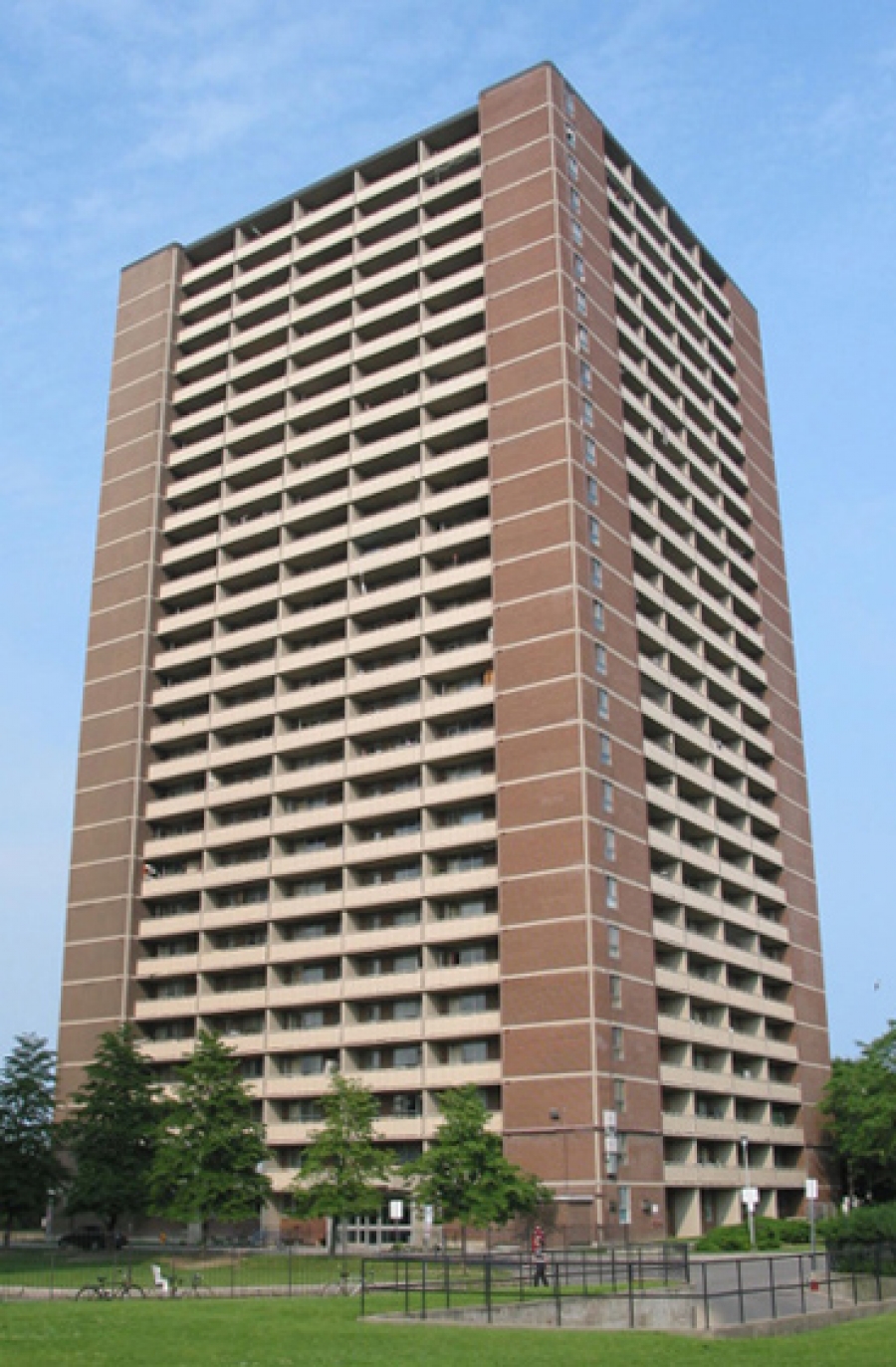
Downtown East resident Miguel Avila-Velarde said the TCHC has acknowledged the need to upgrade aging infrastructure in his building. Plans to revitalize 220 Oak Street kicked off in 2019, but Avila-Velarde said work was stalled by the Covid-19 pandemic.
“The windows were made in [1972] so there is always a problem with heating inside the units,” he said. “The boilers need to change…the electrical system needs to be replaced from top to bottom.”
TCHC hired LGA Architects to upgrade the property in 2021, consulting tenants, staff and city representatives. LGA has completed some ground floor renovations, while the Building Investments, Finance and Audit Committee recently approved a $10 million contract for additional improvements.
Whitzman has urged the federal government to adopt human rights-based housing targets in line with the National Housing Strategy Act. The strategy committed Ottawa to providing TCHC with $1.34 billion in capital repair funding from 2019 to 2027, in addition to municipal funding.
TCHC is not behind on its 10-year plan to repair units in poor condition, Noah Slater, TCHC’s vice-president of facilities management, said in an email to the bridge. However, he added, “Without further investments, TCHC is at risk of having a significant portion of our portfolio go into a critical state of repair.”
And TCHC budget notes show the housing corporation will not meet the 10 per cent Facilities Condition Index (FCI) target set in 2017.
The corporation considers any building that scores below 10 per cent in the index to be in good shape. Data shared with Toronto Star from 2023 showed that 115 of TCHC’s 330 communities met that threshold, while 41 communities were in critical condition.
“If they don’t have funding for the next 10 years of their ambitious state-of-good-repair (plan), they may have to close down units…the worst-case scenario,” said Avila-Velarde.
Walied Khogal Ali, co-chair of the Regent Park Neighbourhood Association (RPNA), said the group continues to hear from residents about building conditions, safety and lack of timely maintenance. “Concerns include delays in critical repairs, gaps in preventative maintenance, and the need for improved safety measures.”
According to TCHC’s 2026 budget, by 2035, FCI is expected to rise by almost 20 per cent across its portfolio, driven by updated repair needs, escalating costs and the loss of federal funding. Aging infrastructure, climate risks and rising construction costs are also expected to pose significant challenges for building maintenance.
Another problem is that social assistance payments have decreased compared with inflation since the 1990s, Whitzman said.
“Social assistance is the express train to homelessness. You can’t afford to rent a room, let alone an apartment on Ontario Works or ODSP, but the majority of people who live in Toronto Community Housing are on pensions or some form of social assistance,” she said. Rent from tenants on social assistance isn’t enough to pay their housing’s operating costs, Whitzman added. (TCHC says 85 per cent of its households pay rent geared to income, mostly at 30 per cent of gross income.)
The provincial government does not fund TCHC repairs, Slater said, but there are “ongoing discussions to explore opportunities for joint investments in public housing.”
Canada uses a metric called core housing need to identify the number of people living in unaffordable and/or unsuitable housing. But it measures only two of the seven aspects of adequate housing set out by the United Nations Human Rights Commission, and habitability is calculated using self-reported state-of-repair data.
“It doesn’t measure security of tenure, even though that’s a really important aspect,” Whitzman said, adding that three per cent of tenant households were evicted last year in Canada. It also doesn’t consider cultural adequacy, access to basic services like clean water, or maximum/minimum temperatures.
“So you could live in a house that’s too cold in winter or too hot in the summer, and if you don’t say the house is in a terrible state of repair, that doesn’t count as housing need,” she said.
Three months ago, CTV News reported that TCHC evictions are at an all-time high, but the landlord said that is incorrect. Earlier reporting considered data only until October 31, 2025, TCHC said, and the eviction rate has remained at less than one per cent for more than a decade.
Khogal Ali said the Regent Park association has noticed a “troubling increase in arrears-related evictions,” pointing to a motion recently adopted by the city requesting that the TCHC consider a moratorium on arrears-related evictions during the municipal election period – “and until a comprehensive, equity-informed plan is brought forward to address the rise in evictions.”
According to data obtained by RPNA through an access to information request, evictions from social housing have increased by more than 100 per cent over the past two years, while Tribunals Ontario data show substantially more eviction outcomes than have been publicly cited.
“Evictions are always a tool of last resort,” Slater said. “TCHC staff take great care and time to support tenants in avoiding eviction. This includes everything from referrals to community agencies and exploring avenues to get their arrears paid through city or agency eviction programs.”
Whitzman said the federal government is writing a new national housing strategy and is meeting with provinces, territories, and municipalities to update agreements. “Otherwise, whatever limited progress is there falls apart,” she said.
Between 2023 and 2025, a report found chronic homelessness in Ontario nearly doubled, while more than 100,000 households were on the waitlist for subsidized TCHC housing as of last December. Depending on unit size, average wait times for rate-geared-to-income units range from 10 to 15 years.