
Anthony Marcusa –
Hundreds of residents crowded into Jimmie Simpson Recreation Centre on March 12 for a “love-in” celebrating the present and future of the Port Lands. The open house marked a chance for visitors to check in on progress and see tangible visions of the future.
“This is very exciting, we’ve waited for so long,” said Councilor Paula Fletcher. “It takes a lot of people to revitalize those Port Lands…This is the love-in meeting.”
Fletcher alluded to community meetings that so often pit developers against residents regarding skyscrapers encroaching on heritage communities. This open house, however, was greeted with enthusiasm and anticipation as the decades-long project entered a new phase with proven victories and specific expectations.
The Riverside centre was quickly at capacity, with 300 residents packing the gymnasium while hundreds more queued outside on Queen Street East. The open house had already been relocated from a smaller venue.
While speeches were relatively short, visitors could check out project information boards and chat with staff from the City of Toronto, Waterfront Toronto and CreateTO, three of the main participants in the Port Lands transformation.
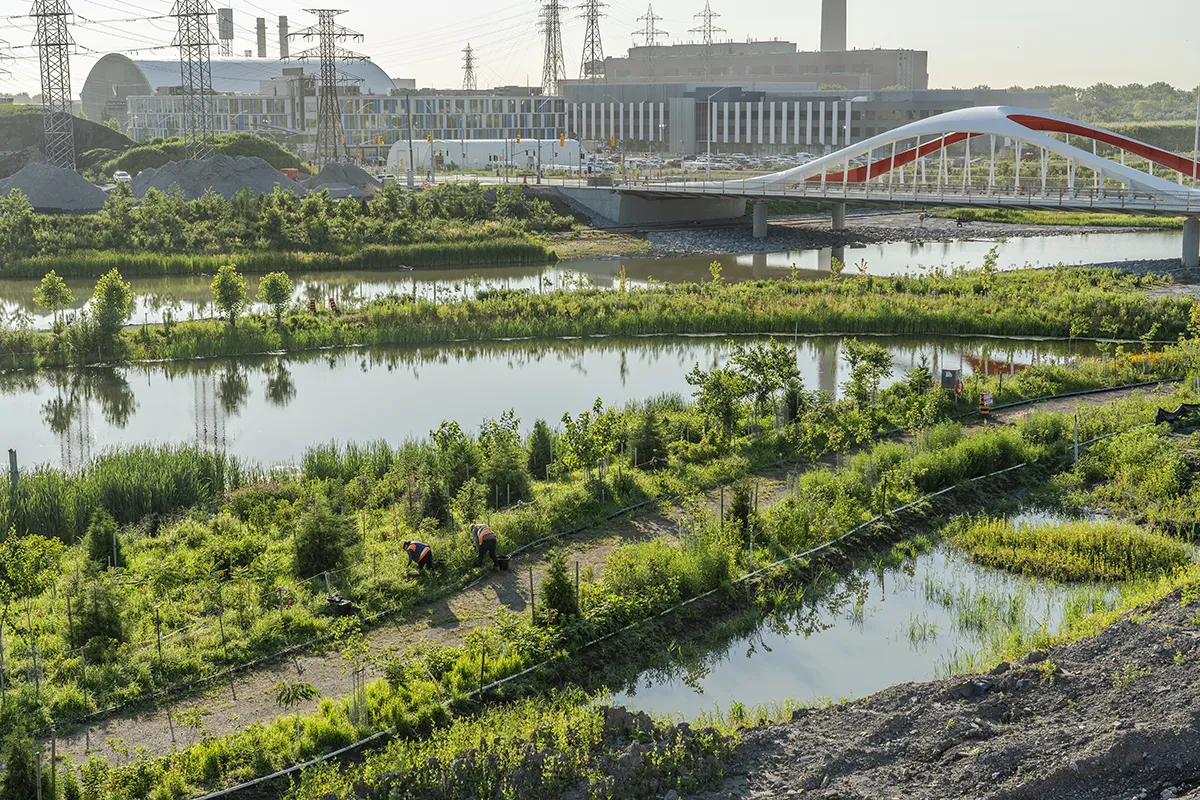
The event focused on Ookwemin Minising (an Indigenous phrase meaning “place of the black cherry trees”), the new island within the Port Lands. Ookwemin Minising is bordered by new river branches to the east and south, a result of a flood protection effort and the naturalization of the Don River.
Ookwemin Minising will be the first of four mixed-use communities opening up in the Port Lands, welcoming over 15,000 residents within about five years. The neighbourhood will include a recreation centre, a library, community space, elementary school, fire station and childcare.
Keating East, Polson Quay, and South River are three other Port Lands communities planned for development over the next 15 years. In total, over 20,000 homes and 40,000 residents are expected.
“We are happy to have affordable housing on the waterfront,” said Fletcher. “There will be 30 per cent affordable housing. Everyone deserves to live on the waterfront.”
The open house featured the long history of attempts to transform the waterfront and the efforts of residents and civic leaders to create a public space along Lake Ontario. In 1988, the federal-provincial Royal Commission on the Future of the Toronto Waterfront began with former mayor David Crombie as commissioner. It later became the Waterfront Regeneration Trust.
The presentation also highlighted that the area will be a destination for workers, with at least 20,000 jobs across sectors including film production and maritime operations. The area also is poised to be a tourist destination, as Ookwemin Minising’s Biidaasige Park opened last summer.
“We’ve developed key visions for how we want the waterfront to change and evolve,” said Jason Throne, the City of Toronto’s chief planner. “We’ll have a naturalized Don River, beautiful new bridges to connect the island to the mainland, play structures, zip lines, off-leash structures, four acres of parkland and a promenade.”
New streets, transit corridors and bike paths will be built to connect the communities to one another and neighbouring areas. “It’s an evolving city within a city,” Thorne said. “We planners like to call this a complete community.”