

By Mike Mastromatteo –
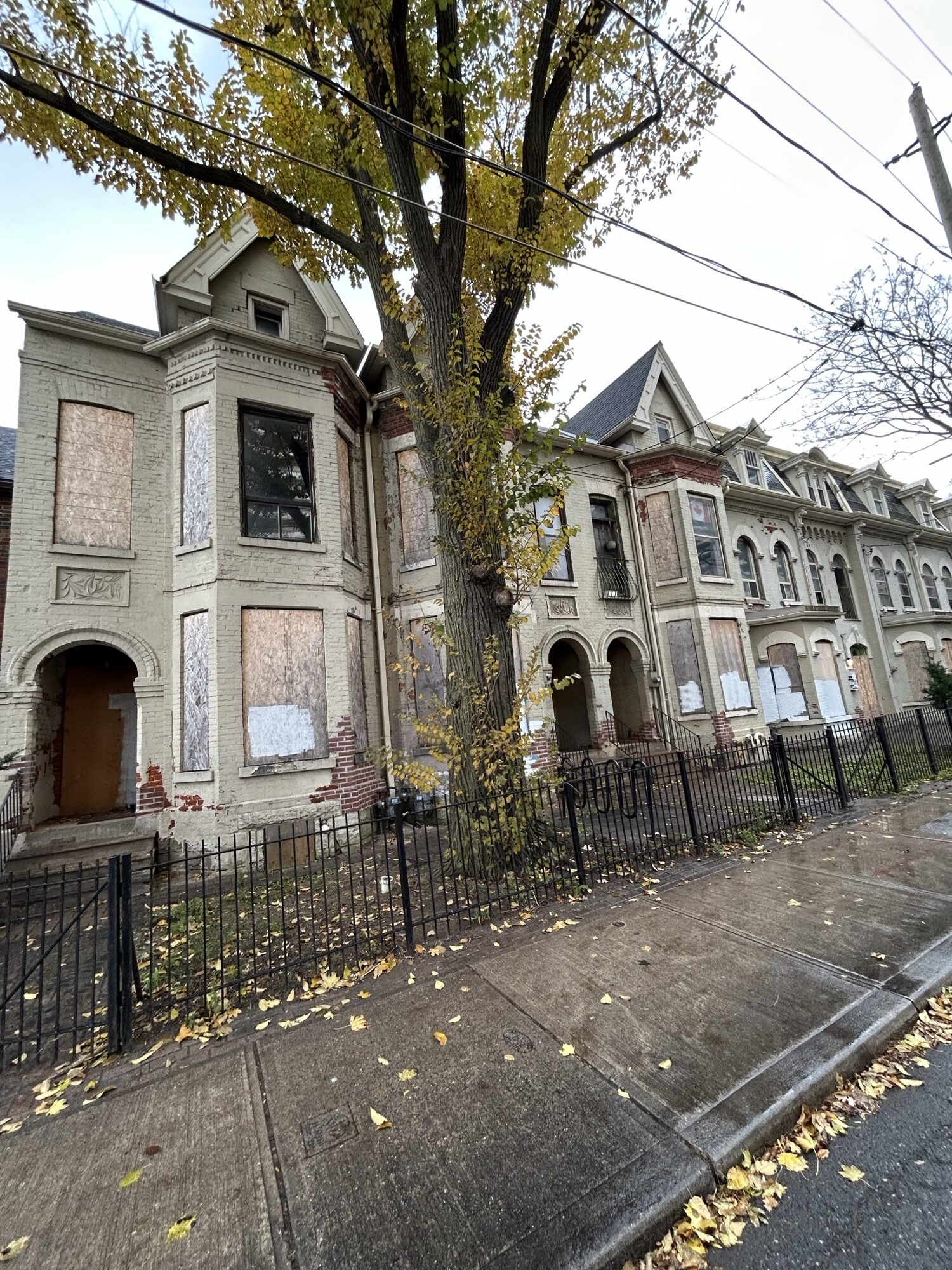
Last issue featured the histories of three elegant but decaying rowhouses on Wellesley Street East near Parliament Street. This month’s “If These Walls Could Talk” focuses on the four eastern-most houses (271–277 Wellesley), which, like their neighbour homes to the west, might soon come tumbling down.
All seven adjoining rowhouses are owned by the Toronto Housing Corporation. The THC and its Dixon Hall partner are babysitting the properties while city officials decide whether to renovate and restore the original structures or replace them with low-cost inner-city housing in a new building.
Alexandra Dinsmore, a communications advisor with the City of Toronto, told the bridge in October not to expect quick action. “The city will conduct a value-for-money assessment to determine whether the housing outcomes are justified by the costs,” she said.
271 Wellesley Street East
Dressmakers, tanners, widows, hat makers and bank messengers resided at this middle house between 1885 and 1920. One occupant hard to pin down is tin metal worker Coleman Miller, who lived there in 1889, but in the 1890 municipal directory is listed as residing at no. 275, two doors to the east.
In the early Depression, labourer Andrew McNamara and his wife Daisy took up residence at no. 271. At a time when jobs were few and wages were low, the house became a refuge for temporary lodgers.
One of the longer occupants was the Farrell family (James, wife Beatrice and son Charles), which owned the home from 1935 until 1955. After James Farrell died, Beatrice rented out parts of the home in the 1940s and 50s. Millwright Robert Hazard and wife Annie were there between 1940 and 1953. The Toronto Daily Star of December 3, 1953, recorded the passing of Annie Hazard “at her residence, 271 Wellesley Street.”
The Globe & Mail of July 29, 1950, sounded another sombre note. It reported the much-too-soon passing of Charles Patrick Farrell of the Ontario Department of Education’s registrar’s office. He died “after a very short illness. He was to be married shortly. A scholar of Greek and Latin, Charles leaves his mother Beatrice Farrell.”
273 Wellesley Street East
Similar to other Cabbagetown homes in the late 19th and early 20th centuries, no. 273 was home to salespeople, general labourers, clerks and tradesmen such as bricklayers and, sadly, widows.
Tradesman Wilfrid Rutz occupied the home from 1932 until about 1940. A pair of widows, Edith H.M. Davidson and AP Cossitt, lived there in the early to mid 1940s.
Underwriter William Calvin resided at no. 273 between 1945 and 1960. Over that 15- year period, he took in renters including John Franklin, Garnet Lapeere and Edward Bannen, a bridgeman with the Department of Public Works.
275 Wellesley Street East
The first three occupants of no. 275 Wellesley were salesman William Whitehead, worker Raymond Padley and religious minister J.T. Church. Tin metal worker Coleman Miller, who lived at no. 271 in 1889, showed up at no. 275 in 1890. He stayed until 1904, when Henry B. Bealey moved in. Identified in municipal records as both a carpenter and a bonds broker, Bealey, his wife Helen and son Contes held on to the property until 1951.
In addition to hosting open houses and receptions, the Bealeys several times lost things. The Toronto Daily Star of March 5, 1908, noted: “Lost – pearl pendant, topaz in center and drop pearl. Mrs. Bealey, 275 Wellesley St.” Some 12 years later, another newspaper ad read: “A bunch of keys lost, Tuesday (March 9). Reward – Bealey, 275 Wellesley.”
Little information was listed about the house in the 1960s. By 1970, no. 275 was shown as a rooming house.
277 Wellesley Street East
Among the early occupants of no. 277 Wellesley – the easternmost rowhouse – was Herbert W. Burgess, a druggist who operated a store at 278 Yonge Street at Dundas. Burgess was related by marriage to Reverend Stuart Acheson of Wiarton, Ontario, who according to the March 14, 1906, edition of the Toronto Daily Star, “… is in town on ‘home missions business’, and is the guest of his brother-in-law Dr. HW Burgess, 277 Wellesley street.”
Widows Amelia Brown and Frances Guise-Bagley shared the home between 1918 and 1938. According to classified ads, one of them advertised the sale of a folding baby carriage ($5) in 1918, a size 36 “Ladies Palm Beach suit, size 36” in 1920, and a “Baby’s English pram” ($9) in 1937.
Alfred Weller, an appraiser with the Sherrin Company at 636 Church Street, moved into 277 Wellesley in the mid 1940s, but spent little time there. The Toronto Daily Star of February 6, 1945, featured the following death: “WELLER, Alfred John, suddenly at his residence, 277 Wellesley street, on Sunday, February 4…in his 58th year.”
The time of single-family use of the Wellesley rowhouses was passing. George Hannivan, a bookkeeper at Woolworth’s department stores, lived there from 1948 to 1952, followed by steel construction worker Rene Duguay in 1953, and bookkeepers Fee and Yee Yam Chong from 1954 to 1965.
The Chongs passed the home down to their son Stephen in the late 1960s, but over the next few years, the home sat vacant and by 1985 was converted into eight separate apartment units.

