

Bruce Bell, History Columnist –
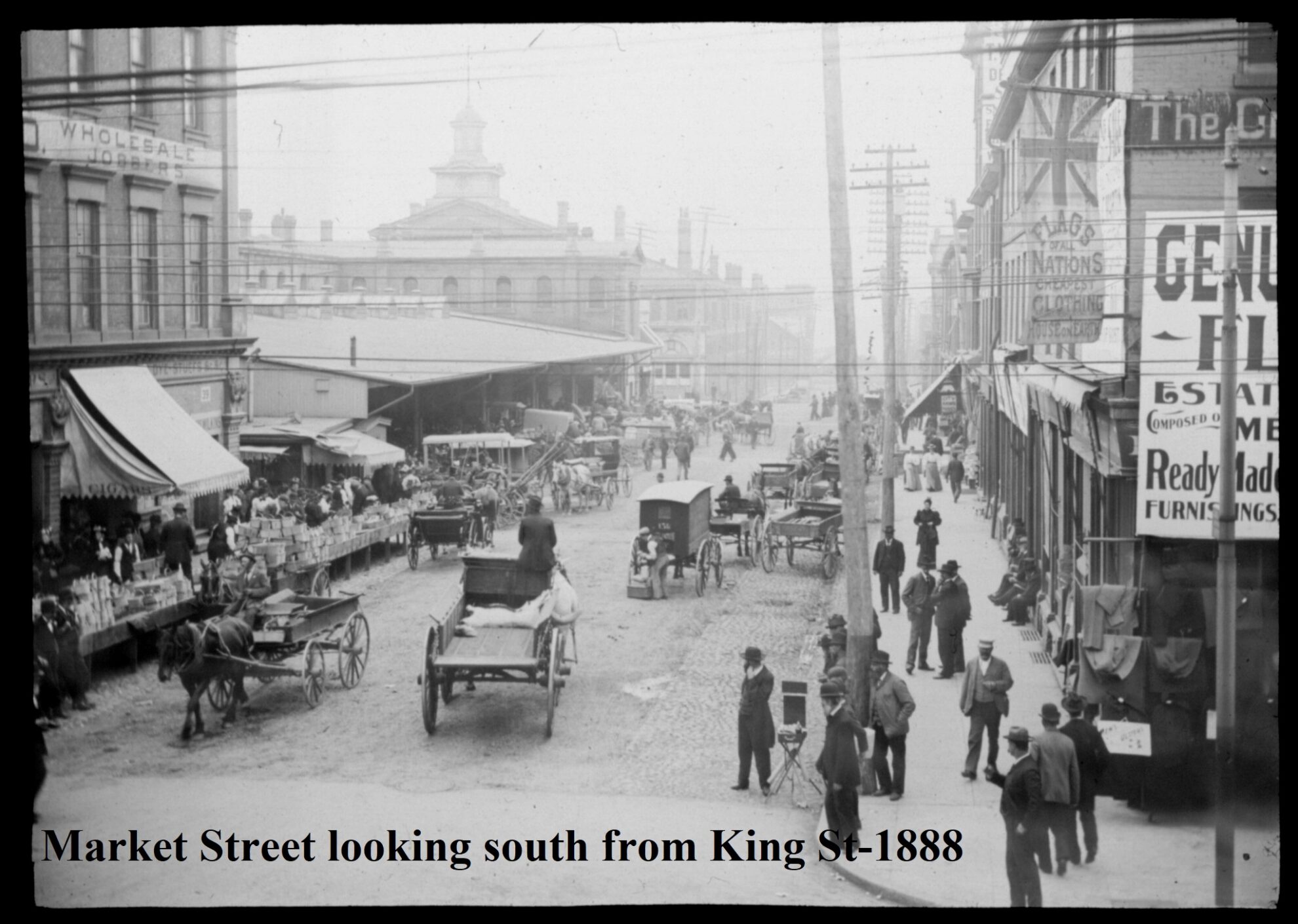
In the spring of 1803, the interim lieutenant governor of Upper Canada, Peter Hunter, decreed that land in the Town of York be set aside for a public market. With that proclamation West Market Street, as it was then known, came into being.
A few months later, in November, the first public market opened on the site of today’s new North Market. In the early 1800s West Market Street stood where the new soon-to-open Market Lane Park stands today, west of the market.
One reason for its location is that for maybe a thousand years previous, it was a gathering place for the First Nations who came south to this area to fish every spring.
The centre of town was at King and Berkeley Streets, where the Parliament Buildings once stood, but the new Market Square (bounded by Front, King, Jarvis and West Market Streets) became the centre of market culture.
In 1832, on the southwest corner of King and Market Lane Park, stood The Wellington Inn, a tavern named for the British duke who had defeated Napoleon at Waterloo in 1815.
The tavern would have been filled with rowdy soldiers and sailors throwing back tankards of ale and spinning tales of fighting side by side with the duke, one of them claiming he saw Napoleon himself retreating in defeat.
In front of the Wellington Inn, owned by James Elliot, was a large sign with a portrait of the duke on horseback on both sides. Elliot died at the inn, which his successor, a Mr. Norris, kept going until 1834 when the building was converted into stores.
A few years later it was converted into a house lived in by the son-in–law of the wealthy landowner and fervent non-drinker, Jesse Ketchum.
In 1849 Ketchum gave Toronto Temperance Street (a block north of Adelaide west of Yonge) on condition that alcohol was never to be sold there, which was observed until recently.
In 1840 a Mr. Halliwell tore down the entire structure and constructed a brick warehouse. In the aftermath of the Great Fire of 1849, it was rebuilt and stood until the urban renewal chaos of the mid-1960s.
Just south of the Wellington Inn on the west side of Market Lane Park, where a tanning salon is today, stood a small one-storey shop named Terry and Catermole Watchmakers. In the 1840s a shopkeeper named Levy moved in and later it became McClellan’s tailor shop.
Next it was Peter Paterson’s Hardware Store, followed by John Bishop’s Butcher Shop. Behind Bishop’s shop was a small slaughterhouse – where Metro’s meat counter stands today.
Next to the butcher shop was a famous hostelry of early York, Franks Hotel. In 1820 the first stage play consisting of local actors took over a second-floor ballroom. Franks Hotel, the site of today’s Market Square Imagine cinema lobby, was also where the aristocracy of early York put on grand costume balls.
Next to Franks was Colborne Street, which then ran all the way from Yonge Street.
In the 1830s at the north end of the park were the public stocks, a place where unruly citizens were publicly shamed. At that time, falling asleep on a sidewalk was considered a crime worthy of hanging; the stocks were used mostly for people who swore in public.
At the south end was an area set aside for the town crier. By 1830 York had numerous newspapers, but not everyone was literate, so the town crier post was essential and highly respectable.
The crier’s main duty was to proclaim royal births, marriages and accessions. When English King George IV died on June 26, 1830, his brother ascended the throne as William IV. The news took six weeks to reach York, where at once the town crier was dispatched to announce it. On the spot where people line up for the TD Bank’s ATM, the following was read aloud in August 1830:
“Hear Yea: William IV is now our lawful Sovereign: to him is due our undivided loyalty, which let us manifest by keeping the closest watch upon whoever may be his Secretary of State for the Colonies for the time being.”
In 1834 the Town of York became the City of Toronto and the Public Market was renamed St. Lawrence Market to honour Canada’s patron saint. Other neighbourhoods were also named for patron saints of the British Empire, such as St. Andrew Ward for Scotland and St. David’s for Wales.
The name West Market Street evolved into Market Street in the early 20th century. Previously, Wellington Street was known as Market Street because it was the direct route to the market, but its name changed to Wellington in 1837.
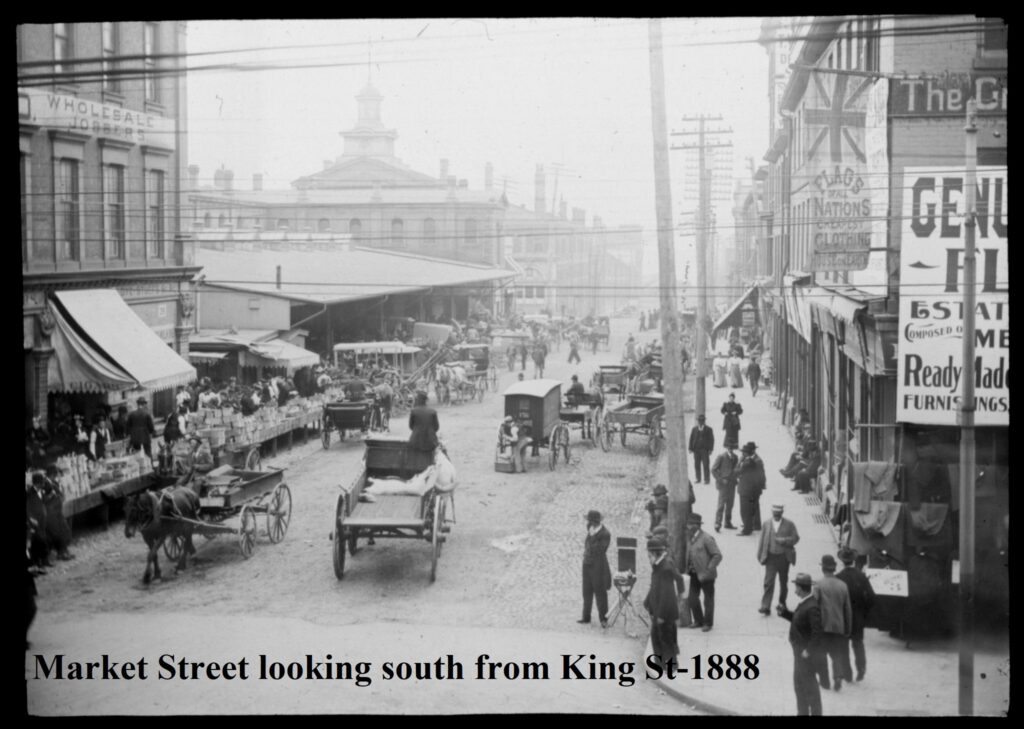
The Market Street of today, south of Front, didn’t come into being until Toronto’s second City Hall (the site of present-day St. Lawrence Market) was constructed in 1844. Before that it was a strip of land leading to a fish market on The Esplanade.
North of King, Market Street ran straight through present-day St. James’ Park, where it became Francis Street. It was named for Francis Collins, an early newspaperman who recorded the first Parliament debates in his newspaper The Canadian Freeman.
Collins died in 1834 during a cholera epidemic; a plaque is dedicated to him in the park.