
Winnie Czulinski –
“Boozhoo!” This traditional Anishinaabe/Ojibwe welcome might introduce a land acknowledgment that says we are “located on the traditional territory of the Mississaugas of the Credit First Nation and other Indigenous peoples who have lived here over time…” And “Toronto is in the Territory of the Dish With One Spoon – “a treaty between the Anishinaabe, Mississaugas and Haudenosaunee that bound them to share the territory and protect the land.”
In Downtown East post-secondary institutes of learning, these words have a special resonance. Whether in June – National Indigenous History Month – or year-round, George Brown Polytechnic and Toronto Metropolitan University boast a rich variety of Indigenous programs, offerings, initiatives and events.
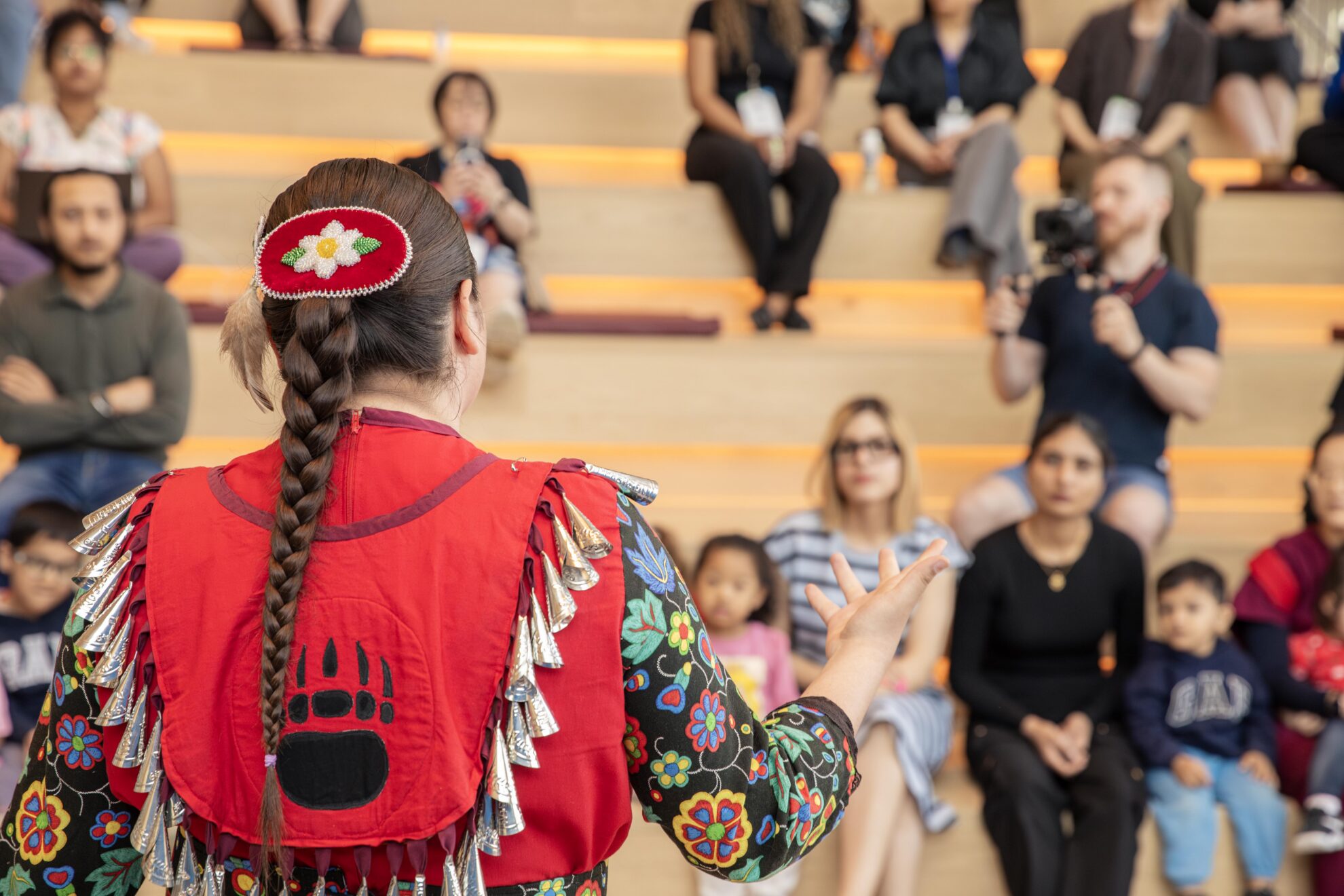
There are Indigenous student services, self-identification processes, bursaries, professional partnerships, arts, foodways programs/urban farms and medicine gardens, culinary education, onsite elders and knowledge-keepers, mentoring, rebirthed teachings (Kiwenitawi-kiwin Kiskino-hamatewina), medallion star-blankets, and more.
One offering, “placemaking,” is a collaborative process that shapes and contributes to public spaces of restoration, inclusiveness, human achievement and spirit, creating meaningful community. Both George Brown and Toronto Metropolitan have been offering Indigenous programs and initiatives for more than 30 years.
George Brown Polytechnic operates three campus-specific Indigenous Student Centres (Sahkitcheway on King Street East, Jiigibiik nibwaakaawin teg in a 10-storey timber building on Queen’s Quay East, and Wi Chi Hito Win at the Casa Loma campus) that offer mentorship, emergency funding support, and cultural teachings such as “The Thirteen Moons” and “The Truth the Wampum Tells.”
TMU’s main campus spread across the Downtown East core, has Gdoo-maawnjidimi Mompii – meaning, as the TMU website says, “We Gather Here” – with support services, programs and the Indigenous Student Centre under one roof.
University of Toronto also has Indigenous centres and resources, including a tuition initiative. U of T Indigenous faculty cover subjects such as Environmental Justice, Under-Representation of Women and Indigenous People in Engineering, Indigenous Law, Language Documentation and Revitalization, Indigenous Politics and Water Governance, Anthropological Theory and Indigenous Media.
Both TMU and George Brown also have reached far beyond the city to share knowledge, help and hope. Professor Farrokh Janabi-Sharifi of TMU’s Faculty of Engineering and Architectural Science has been working with a team, the National Research Council, and Cowichan groups in British Columbia, to develop drones to deliver essentials to remote communities, the first project of its kind.
“The technology started as a way to help Indigenous communities, but can also be adapted to serve other remote or isolated areas across Canada and beyond.”
George Brown’s 2024/2025 Indigenous World View Exchange with New Zealand’s Nelson Marlborough Institute of Technology had some of its students travelling to connect with Māori learners from Te Tauihu (top of the South Island, in Aotearoa) in a community-based field course, with educational, cultural and spiritual sites and activities. Then Māori participants came to Toronto for a similar experience, visiting locations ranging from Niagara Falls to a Toronto Council Fire Indigenous legacy gathering.
Aedan Alderson, Professor of Indigenous Studies and General Education, who helped design the project, said in a 2025 OISE (Ontario Institute for Studies in Education) talk, “For learners, the inaugural worldview exchange program between NMIT and GBC…allowed them to immerse themselves in Indigenous ways of knowing and being in Aotearoa and the Southern Ontario region, while building their own connections to both regions as Indigenous peoples.”
At Toronto Metropolitan University, two artists from opposite sides of the globe – Inuit artist “Niap” (Nancy Saunders, from Kuujjuaq, Nunavik) and Peruvian artist Olinda Reshinjabe Silvano – came together to co-create an enormous landscape painting. As a video by Kristen Geiger about the project says, the 39-by-26-foot mural at Gould Street and Nelson Mandela Walk has become “a focal point of Indigenous placemaking in a city that sits between the Arctic and the Amazon.” The artwork was completed as the university dropped its Ryerson moniker in 2022.
George Brown, too, has its distinctive Indigenous visual presence, from wall art to logos – and relationships with other initiatives. Participants of the school’s non-degree virtual “Wisdom” (Nibwaakaawin) course celebrated “graduation” at a vibrant mural in Hagersville, Ont. Chilean art collective Alapinta, with South America’s Mapuche “people of the earth” heritage, had worked with Six Nations/Brantford youth and community members on this intercultural panorama.
Somehow, such placemaking aligns well with acknowledgements at George Brown and TMU such as, “We are grateful to share this land as treaty people who learn, work and live in the community with each other” and “Subsequent Indigenous nations and peoples, Europeans and all newcomers have been invited into this treaty in the spirit of peace, friendship and respect.”