
Paul Dilse –
The recent raft of planning approvals for high-rise towers along Sherbourne Street is not the first planned assault by the city on the historic neighbourhood of Cabbagetown.
Toronto’s repeated reversion to discredited top-down urban planning makes me think encouraging high-rise redevelopment is about more than making money for the city and keeping tax-funded city planners employed by processing development applications.
Toronto has long envied New York and its towers. Writing in the magazine Construction in 1930, the architectural critic “Sinaiticus” (a.k.a. H.H. Kent) gushed over the erection of a high-rise office tower as the most “New-Yorkish” of all.
In Toronto Architecture: A City Guide, Patricia McHugh mentions a 1955 recommendation from the city parks department to demolish all existing housing between Allan Gardens and Moss Park to create one sweeping “Central Park” for Toronto. Staff envisioned luxurious New York-style apartment houses rising around the new open space.
The clearance of Victorian housing for the 33-acre St. James Town private scheme built between 1959 and 1970 was enabled by the city’s zoning provision for a “special exemption area” to permit a high population density. In his 1990 study, Gilead Kay concluded that the blocks of Victorian housing that were destroyed “resembled anything but a blighted area.” The high-rise towers and their 6,000 apartments that had been marketed to “the younger set” quickly deteriorated.
Former mayor John Sewell’s 2015 memoir, How We Changed Toronto..., tells the story of South St. James Town and the battle he, Karl Jaffary, community organizers and residents waged against Meridian Developments in the blocks south of Wellesley Street East. By 1968, Meridian owned almost all the 80 Victorian houses in the Bleecker and Ontario Streets block, and about 75 in the rest of the area that Meridian wanted for its southward extension of high-rise towers.
Meridian had assembled the family homes, one by one, renting them out as rooming houses, and allowing them to fall into disrepair, evicting tenants and – at the point of no return – demolishing them.
The 1974 video, Free Bleecker, adds compelling graphic footage to Sewell’s account of how Meridian used police in 1972 to force the eviction of tenants from a Bleecker Street house.
The city had abetted Meridian by designating the area a redevelopment area. But Meridian’s plans were eventually foiled. The area was built up with a gentler density of affordable housing around Winchester Square (Park) in the early 1980s, and houses Meridian had not yet demolished were saved.
Meanwhile, middle-class professionals and academics were rehabilitating the neighbourhood’s remaining Victorian housing stock. These people organized in the late 1980s to protect their investment in renovated semi-detached and row houses and advocate for the neighbourhood’s preservation.
In the late 1990s, the Cabbagetown Preservation Association embarked on a multi-year project to establish heritage conservation districts. Designated under the Ontario Heritage Act, the districts would permanently protect the neighbourhood’s historic buildings from demolition. A novel method for the time was adopted: designate a small core area of properties and then add blocks until the whole neighbourhood was heritage designated.
City staff gave the association’s volunteers the seemingly impossible task of researching the history of every single property within the proposed district. But the indefatigable Peggy Kurtin and her pals ground through microfilm at the City of Toronto Archives every week until they presented the complete results to city staff. A plan for the first district was made in 2001 and City Council designated the district the next year.
Five contiguous heritage conservation districts now blanket almost all of Cabbagetown. In addition, Allan Gardens and Sherbourne Street south of Gerrard Street East are designated in the Garden District Heritage Conservation District.
The establishment of heritage conservation districts with their statutory plans that prevail over the official plan and zoning by-laws should have ended the city’s dreams of high-rise redevelopment. But since 2021, the city has approved three “point towers” ranging from 18 to 39 storeys in the neighbourhood’s protected heritage areas plus a 42-storey tower on the west side of Sherbourne Street opposite a 35-storey tower.
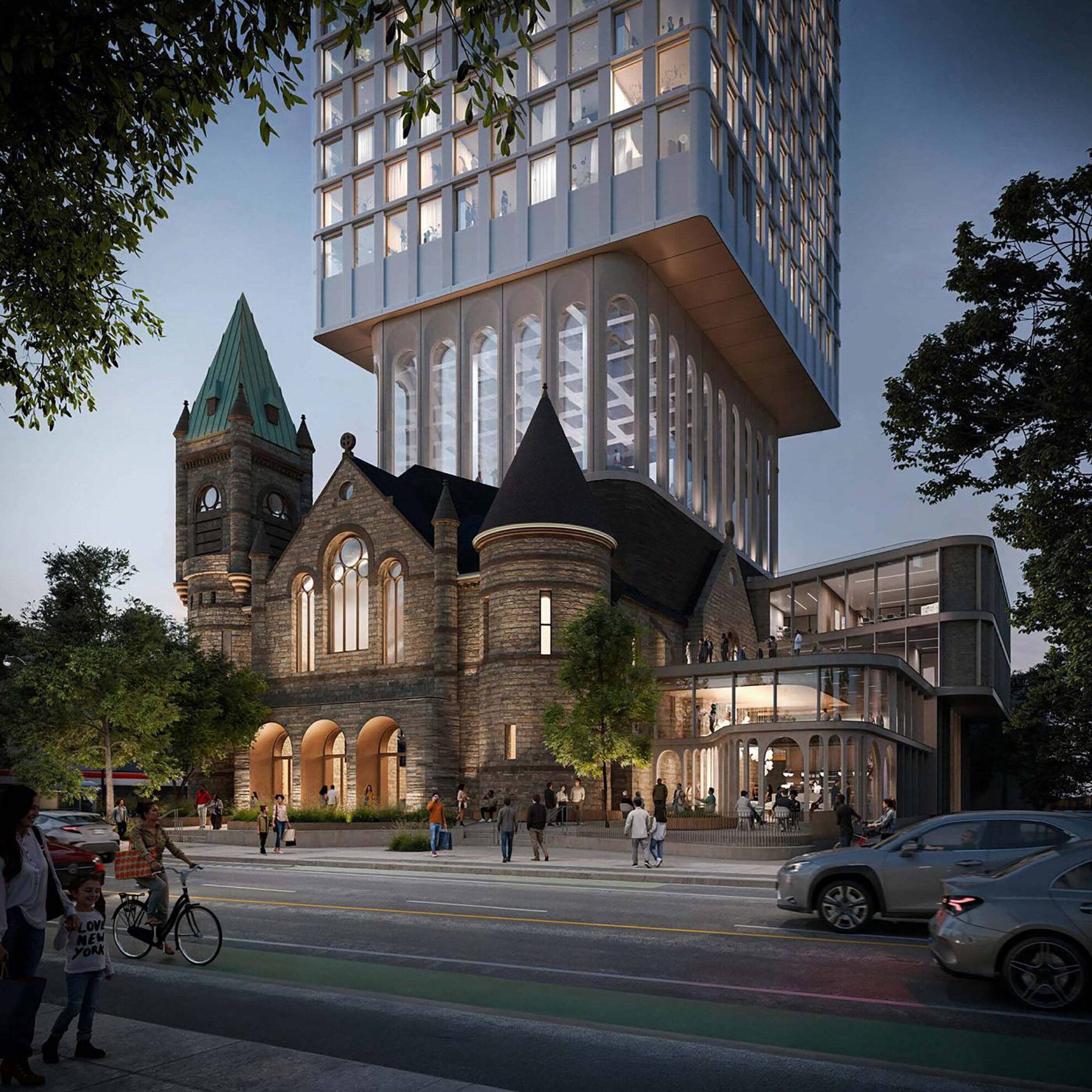
The fate of St. Luke’s Church, which has anchored the southeast corner of Sherbourne and Carlton Streets for nearly 140 years and is protected in the Cabbagetown Northwest Heritage Conservation District, hangs on a City Council decision in early February. Toronto and East York Community Council has recommended approval of an application by Kindred Works to replace the church with a 48-plus-storey point tower. All that would be left of the church would be some of its Credit Valley sandstone walls and the outermost parts of its picturesque roof line. The retained bits would be connected to the new tower’s structure.
One of the renderings depicting the outlandish proposal shows a little girl walking on the Sherbourne Street sidewalk in the foreground. Her T-shirt says, “I Love New York.”
The Toronto Preservation Board has recommended that City Council refuse the application.
Paul Dilse is a longtime neighbourhood resident and a retired heritage planner.