
Bruce Bell –
One of the more fascinating characters of early Toronto was James Austin, whose legacy remains in our city’s landscape in the buildings and institutions he left behind.
At the age of 16, James and his parents arrived in York (now Toronto) from Ireland in 1829. Soon after, he was taken on as a printing apprentice to Toronto’s first mayor and later rebel leader, William Lyon Mackenzie, in his shop on the northwest corner of Front and Frederick Streets.
For the next decade James learned a valuable trade and important life lessons from a man who changed the face of Canadian history. After Mackenzie’s ill-fated 1837 Rebellion against the powerful Family Compact, James thought it best to leave the country for a while (as did Mackenzie). Looked upon as a supporter of the rebels, he did not want to share the fate of two others on the gallows following the defeat.
When the dust cleared, James returned to Toronto and met up with entrepreneur Patrick Foy. In 1843 the two men opened a wholesale grocery business in the elegant Daniel Brooke Building, still standing on the northeast corner of Jarvis and King Streets. The grocery business boomed.
The Great Fire of 1849 devastated much of the old wooden downtown core, making way for a city built of stone and marble.
In the fire’s aftermath, city planners discussed building a magnificent centrepiece for the city, and James wanted to be a part of it. He purchased a lease at the southwest corner of King and Jarvis, which eventually became a bank, in the stunning structure known today as St. Lawrence Hall.
When he arrived in York in 1829 the population was only about 2,000, but with the coming of railways, the building boom after the Great Fire plus the influx of starving Irish fleeing famine, Toronto’s population was close to 50,000 by 1850.
Austin loved Toronto and enjoyed carriage rides roaming the streets and making mental notes of what he saw. He always noted whether the clock of the cupola above St. Lawrence Hall kept the correct time. Before inexpensive wrist watches and because only a handful of wealthy men could afford pocket watches, that great clock was the city’s main timekeeper.
Only in 1875 was the hall’s clock surpassed by its neighbour’s at St James’ Cathedral across the street, itself outdone by ‘Big Ben’ at the new City Hall in 1900.
By 1859 James had sold his shares in the grocery business, a financial windfall, and bought stock in Consumers’ Gas Co., which elected him to the board of the bourgeoning gas company and later as its president.
Consumers’ Gas was founded in 1848 as the brainchild of another 19th-century industrialist, Charles Berczy (Berczy Park behind the Flatiron Building is named for his family). Eventually this company became known as Enbridge Inc.
As his fortunes grew, James Austin decided to build a magnificent home in 1866 atop the escarpment overlooking Spadina Road. The same year saw the last gasp of the former Family Compact when their once mighty Bank of Upper Canada collapsed. A new wave of mostly self-made men took up the slack.
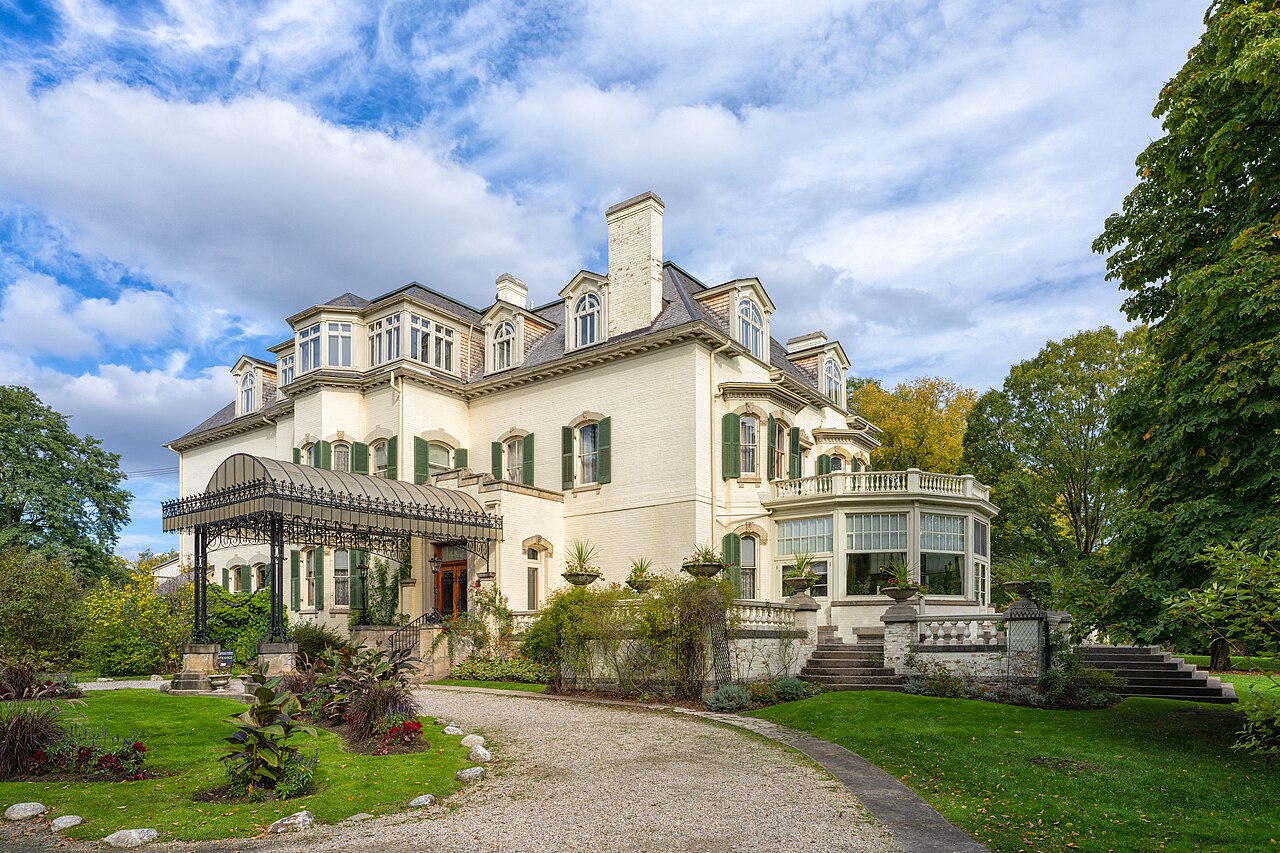
Still standing, Spadina House is a city museum of how the very rich lived at the height of the Victorian era.
In its day, Spadina House was the centre of social activity for Toronto’s elite. Unlike its latermore imposing neighbour next door, Casa Loma, which Sir Henry Pellet abandoned when nearly bankrupt after only 12 years, Spadina House was occupied from its construction until 1982 by Austin’s descendants.
In 1871 James Austin took his place along side men like William Gooderham, John D. Rockefeller and Cornelius Vanderbilt when he founded the Dominion Bank, remaining its president until his death in 1897
In 1871, James Austin’s new Dominion Bank opened at 40 King Street East, quickly followed by a branch on Queen Street West. This was the first time a Canadian city had two banks of the same name; Austin is seen today as the father of Canada’s branch banking system.
In 1914 a new Dominion Bank headquarters arose over the demolished rubble of the old one on the southwest corner of King and Yonge Streets. As with Austin’s previous structure, Torontonians gasped at its beauty; it is now a hotel condo complex known as One King West.
James Austin, the determined young lad of 16 who arrived in York in 1829 from Ireland, died on February 27, 1897, at the age of 84.