
Winnie Czulinski –
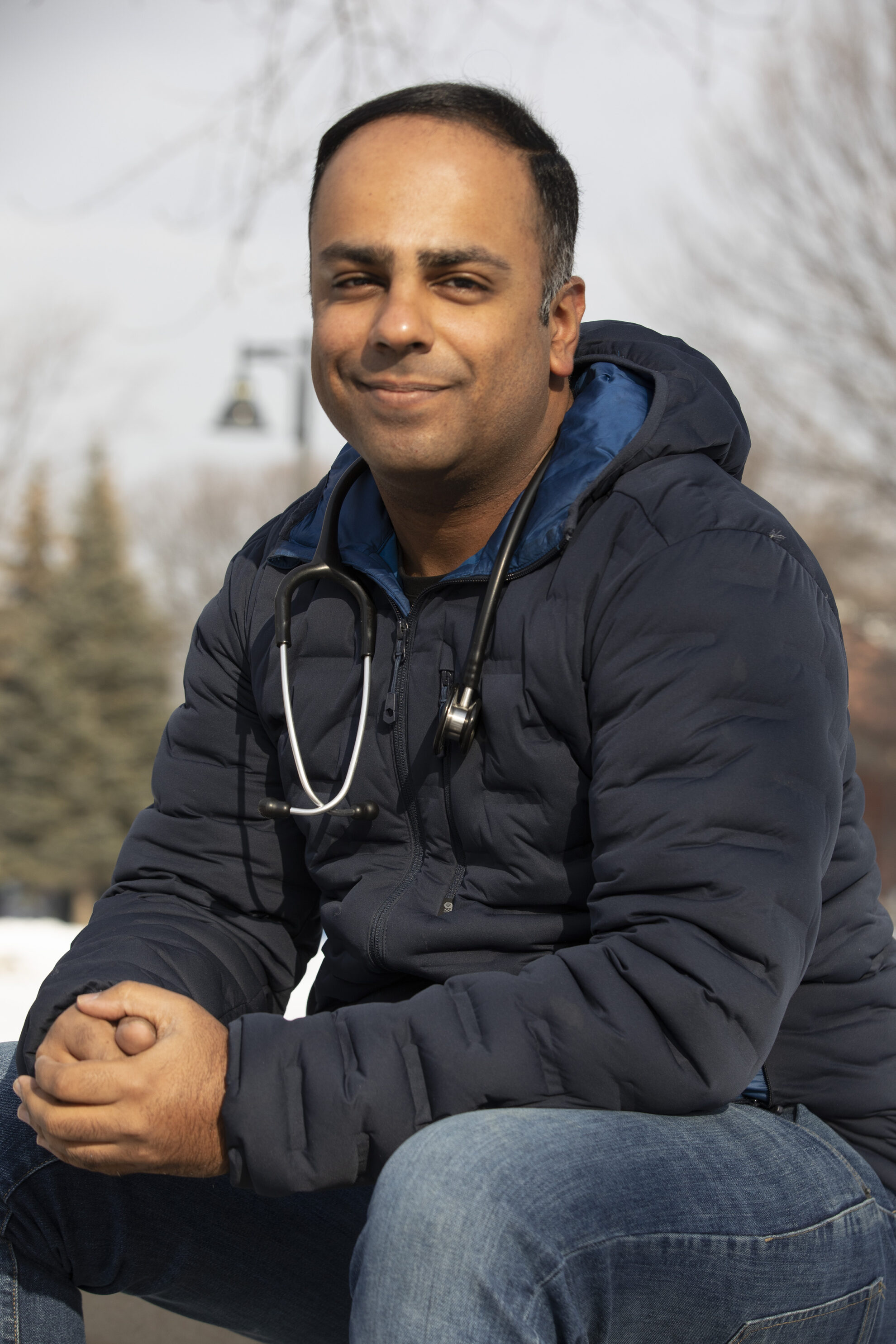
When Dr. Naheed Dosani examines and cares for a patient, it’s likely to be on a park bench, on the street, or in an encampment or shelter. His mission is with the city’s unhoused/vulnerable people who are dying.
As a resident trainee at the University of Toronto, Dosani was working in a local men’s shelter when he met Terry, 15 years on the street, with a widespread head/neck cancer. “I was shocked that a man like this could not get access to the kind of care he needed in a city like Toronto with its world-class care.” Before the doctor could help him, Terry made his choice: an overdose of alcohol and street drugs.
After Dosani graduated in 2014, he founded (and leads) the world’s “first and now largest mobile palliative care program that focuses specifically on structurally vulnerable populations.” PEACH, Palliative Education and Care for the Homeless, is a trailblazing 24/7 concern.
“We started out of the back of my Honda Civic driving around one day a week,” says Dosani, a palliative-care physician at St. Michael’s Hospital. “After the first year, we showed that 64 per cent of our clients never went to the hospital or ER, 80 per cent died where they wanted to, and 83 per cent were reconnected to family and friends.”
PEACH is fostered by Inner City Health Associates on Front Street East, formed in 2005 by physicians working with Toronto’s homeless and precariously housed population. It works also with Toronto Central Health at Home, and Kensington Health, which operates a ‘Radical Love’ low-barrier access hospice.
Canada’s universal healthcare system doesn’t work for everyone. Those with no Ontario Health Card, who can’t travel to medical appointments, who have painful past experiences with healthcare professionals, etc., need comprehensive help when facing the end of life.
Dosani, also a researcher at St. Michael’s Hospital and at the MAP Centre for Urban Health Solutions, has many awards for his medical/humanitarian work. The son of Indian-Ugandan refugee parents who fled war and persecution in the 1970s, “I learned very quickly how health inequities can play out in communities like Scarborough, Ontario. I always knew I wanted to be in a career and field that put those kinds of (core) issues at the forefront.”
PEACH cares for between 120 and 140 clients across Toronto at any given time, with a team of physicians, nurses, peer workers, health navigators, social care workers and home care coordinators/professionals working in non-traditional settings. “We’re really grateful to be on the cutting edge of an innovative model of care that puts equity and human rights at the forefront.”
The need for care for terminally ill homeless people in a big city is enormous. Journey Home Hospice on Shuter Street opened in 2018 as an initiative of the Saint Elizabeth Foundation, a national charity supporting end-of-life care for vulnerable people.
Felicia Kontopidis, a former visiting home care nurse with SE Health, now works as Journey Home Hospice’s director of care with an interdisciplinary team. “Having observed how care is accepted, received and processed by patients has reinforced how complex end-of-life care can be, especially for those who aren’t just physically unwell, but may also be struggling with mental health issues, trauma and substance use.”
Besides medical professionals, the hospice offers spiritual and complementary care providers, and “a wonderful group of caring volunteers.” Among resident testimonials, the story of Nicole (1974-2018) details a horrific spiral from a hammer-abused middle-class mom to oxycodone addict and cancer sufferer on the street. She feared “not only dying alone, but with no one knowing you were just a normal person who had a hard time.”
Kontopidis says, “I think the future is about branching out with what we’ve learned to help educate the broader community – including all those who are involved in the care of marginalized populations – like families, caregivers, and anyone interested in trialing a compassionate approach.”
Dying residents getting palliative care are also assisted by the Good Wishes program offered by Dr. Dosani and his PEACH colleagues. That might be a gift of clothing, a guitar, funeral expenses, tickets to a local theatre play or Blue Jays game. “They may feel shame, and don’t believe they deserve it,” says Dosani.
One man, Richard, found he had a talent. “And so we got him some soap sculpting supplies, so he could spend the time he had left doing the thing that he loves.”
Richard focused on sculpting angels. They, along with Dosani and the PEACH team, were his “protectors.”