

Bruce Bell, History Columnist –
Live theatre in early Toronto was a popular pastime, but not a place where ‘proper’ women would be seen, let alone act on stage. Heaven forbid!
So looked down upon was theatre that in 1829 a series of scandals involving theatrical folk led to all public performances in York being banned for a few years.
Looking for a loophole in the law, in 1834 the enterprising Waugh brothers took over a former Methodist church at the corner of King and Jordan Streets (just west of Yonge Street) and transformed it into the Theatre Royal. There the brothers presented Panoramas of historic events with huge painted canvases surrounding the audience. With no live actors or bawdy language, Theatre Royal become a proper place for women and children to go.
Decades later the colossal Cyclorama was constructed on Front Street West, where the audience viewed mammoth Panoramas depicting titles such as the U.S. Battle of Gettysburg or “Jerusalem on the Day of Christ’s Death.”
Panoramas and the Cycloramas that housed them had reached their peak when vaudeville arrived. On October 24, 1881, the 14th Street Theater in New York ushered in a new genre of entertainment that swept through the United States and Canada.
Vaudeville was what streaming television is today, something for everybody, with enormous mass appeal and influence that would last 50 years.
A typical vaudeville show opened with an animal act, pantomime or acrobatic act, anything that didn’t have to hold the audience’s attention as they found their seats. The headliner or featured act appeared just before intermission in the star spot, a mere ten minutes that every vaudevillian aspired to attain.
On Monday, August 31, 1896 a handful of Torontonians attending a vaudeville show also happened to glimpse an awe-inspiring innovation: the first motion picture shown in our city.
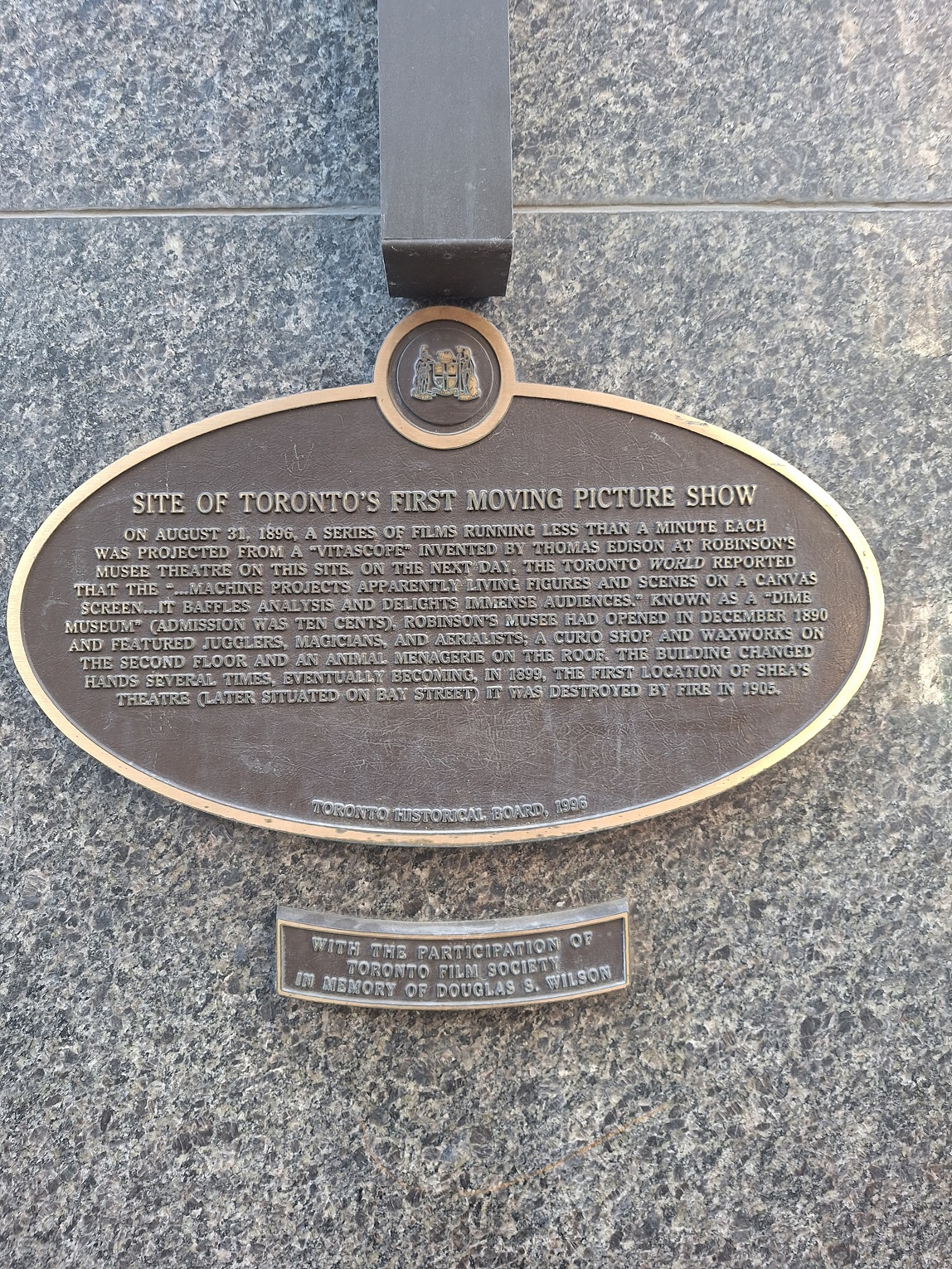
The site of Toronto’s first moving picture show was Robinson’s Musee Theatre, on the southeast corner of Yonge and Richmond Streets (a plaque marks the spot). The 47-second silent motion picture shown there changed the course of entertainment not only here in Toronto, but the entire world.
That first film, The Kiss staring May Irwin and John C. Rice, caused a sensation. The film showed a married couple kissing, somewhat shocking then. Early films shown in Toronto were projected using a new-fangled gismo called a Vitascope, by American inventor Thomas Edison.
Robinson’s Musee Theatre, opened in 1890, had featured live performances by jugglers, magicians, and ever-popular dancing dog acts. For the next few decades, vaudeville and silent motion pictures (often accompanied by live music) shared theatre bills in relative peace.
The first theatre built to show movies in Toronto was the Colonial Theatre, opened in 1910 with 477 seats on the southeast corner of Queen and Bay Streets across from Old City Hall. After enthralling audiences for 60 years (later as the Bay Theatre), it was demolished in 1969 and replaced with the present Simpson Tower.
The first talking motion picture shown in Toronto was on December 28, 1928, at the Tivoli Theatre on Richmond Street (now the site of the Cambridge Suites Hotel). The late movie historian Richard Fiennes-Clinton told me about that momentous night:
“At midnight, over a thousand Torontonians went to see a horror movie called The Terror complete with shrieks, yells, screams and – most thrilling of all – the sound of people talking! It would be a cultural game changer just as TV and the internet would be decades later.”
‘Talking pictures’ killed vaudeville, but vaudevillians who could speak well enough to be recorded went on to have long careers in talkies: W.C. Fields, Milton Berle, Red Skelton and Canadian great Marie Dressler.
The Jazz Singer, starring Al Jolson, is recognized as the first big studio-backed talking motion picture when it was released in October 1927. However Toronto didn’t get The Jazz Singer until January 1929, a few weeks after The Terror opened.
The female co-star both in movies was May McAvoy. As a woman on stage, she would have been demonized a mere hundred years previous.