
Bruce Bell –
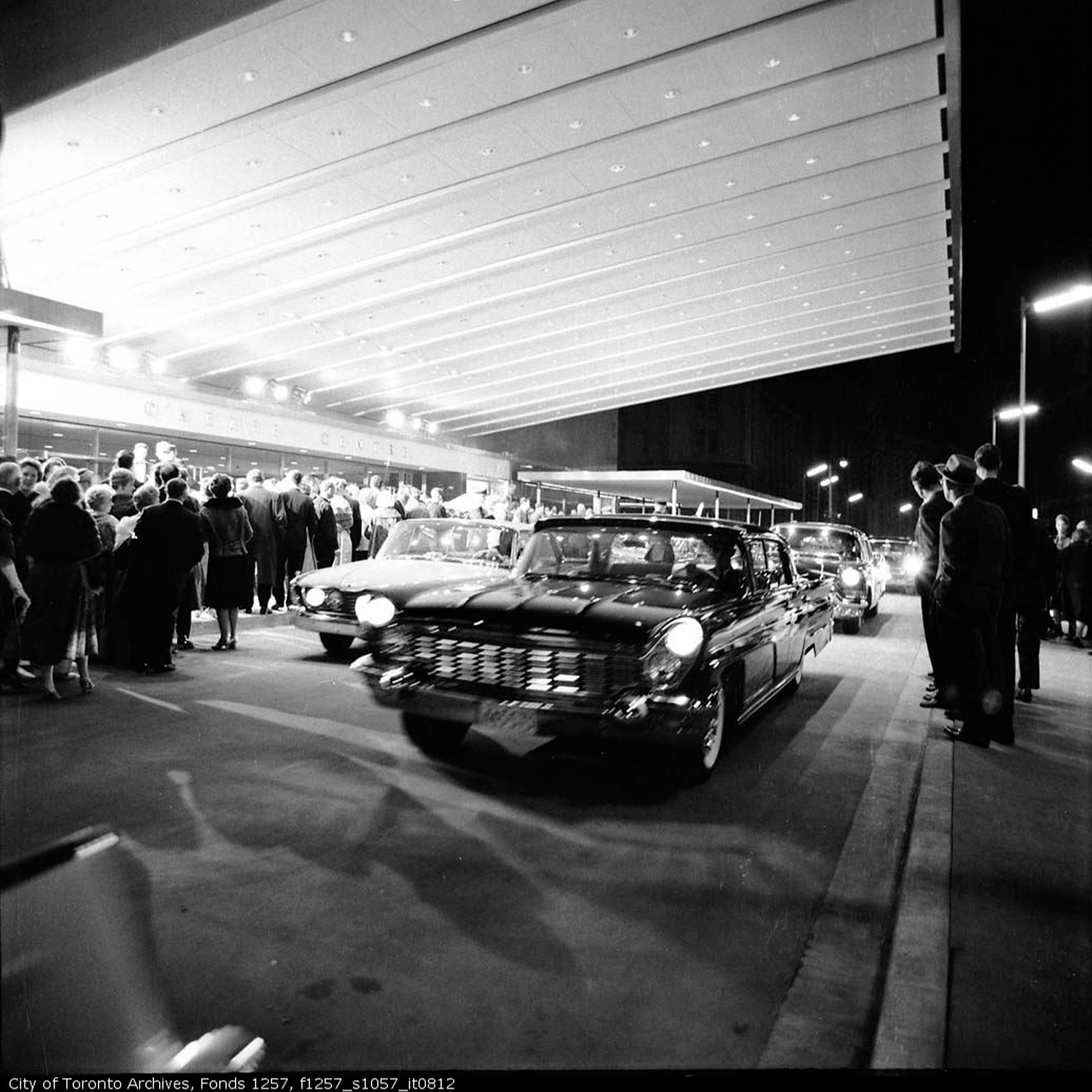
On October 1, 1960, Toronto entered a new cultural age: the brand-new O’Keefe Centre for the Performing Arts (named for its giant brewery benefactor) opened its doors.
The opening production was the first pre-Broadway tryout of the musical Camelot starring Julie Andrews, Richard Burton and Canadian Robert Goulet.
The O’Keefe Centre (now called Meridian Hall) was to represent to the world that sleepy Toronto, a city where it would still be a quarter of a century before Sunday shopping was allowed, was a vibrant place with a thriving arts centre.
In 1830 the site was the location of the Freeland Soap and Candle Factory, considered Toronto’s first industry. The name Peter Freeland was well known, for his candles lit the homes of York’s first citizens before electricity and light bulbs arrived.
By the beginning of the 1850s a railroad moved in with the belching smoke of steam engines and in 1866 the Great Western Railroad Station replaced the candle factory. Today the only remembrance of Peter Freeland and his factory is Freeland Street just east of Yonge between Lakeshore and Queen’s Quay near the Loblaws store.
At the beginning of the 20th century the station was converted into a wholesale vegetable market. But on May 17, 1952, the building was destroyed by fire and for the next few years the site became a parking lot.
In 1957 the remaining buildings facing Front Street, mostly warehouses, were demolished to make way for the O’Keefe Centre.
The history of the O’Keefe Centre can be written by past and present residents of my Esplanade home PAL (Performing Arts Lodge).
One of our first residents was Mary Jolliffe, O’Keefe’s first public relations director, responsible for media arrangements for the theatre’s opening and first season. Her favourite memory, she told me, was escorting Richard Burton on his arrival to sneak a look at the new auditorium.
Burton peered into the vast expanse of the luxurious beer-financed 3,000-seat house, turned to her and exclaimed: “God! Think of the hangovers that went into that!”
Another PAL resident at that opening night was the late Herb Whittaker, then drama critic for the Globe and Mail. He wrote:
“When you approached the theatre you visualize it as a ship, with the sharp prow of the modern marquee followed by the great bulk of the auditorium, and making a wonderful contrast with the rosy brick buildings of Old Toronto.”
One of the first new artistic features seen when entering the main lobby is the whimsical yet powerful mural by York Wilson. In a time when theatre lobbies were dominated by landscape or portrait oil paintings representing a bygone era, this was boldly new. The mural depicts “Seven Lively Arts” (its name): painting, sculpture, architecture, music, literature, dance and drama.
Indeed, the O’Keefe stage saw greats from the worlds of ballet and opera, Broadway and London, and home-grown theatrical giants.
The late Hugh Walker another of PAL’s eminent residents, was general manager of the O’Keefe Centre from 1960 to 1975. His wallet always carried a photograph of himself showing the architectural model of the facility to a young Queen Elizabeth in 1959.
Another PAL resident who performed many times at the O’Keefe as a member of the Canadian Opera Company is Arlene Meadows, my neighbour at PAL since opening day.
While performing in Salome with the COC in 1965, Arlene told me, an enormous rain storm broke out in Toronto. When the cast went out for their curtain call, she could still hear thunder and rain – but soon realized it was rousing applause from the audience.
In 2016, a massive condominium known as the L Tower opened atop the back of the O’Keefe Centre. It was constructed to look like a candle flame, reminiscent of the Freeland Soap and Candle factory that once stood on the site.
Designed by Toronto architect Peter Dickinson, the O’Keefe was owned by the old City of Toronto and sold to Metro Toronto in 1968. Despite municipal involvement, commercial considerations led to several name changes: to the Hummingbird Centre (in 1996, for a software company), the Sony Centre (2007) and the Meridian Hall (2019, for a credit union).