
Dennis Hanagan –
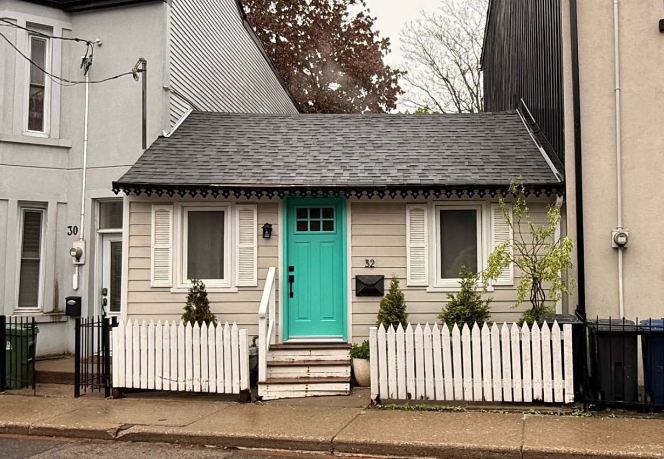
City Council voted in July to preserve a tiny 164-year-old cottage at 32 Bright Street in Corktown as a rare example of how Toronto workers lived in the 1800s.
Council is now looking at whether Corktown itself should be declared a Heritage Conservation District (HCD), which would empower the city to preserve Corktown’s 19th-century character.
32 Bright Street is one of 18 pre-1870 properties across the city that have been listed on the Heritage Register for possible designation under the Ontario Heritage Act. But there’s a threat from the province – an amendment to the act requires listed properties to be either designated “or removed” from the register by the end of this year.
The single-storey, four-room, wood-frame, modestly ornamented Bright Street cottage was occupied from around 1862 to about 1928 by the Irish Costigan family. Gary Miedema, project manager with the city’s Urban Design, said in a statement to the bridge the cottage is directly linked “to the wave of Irish Famine-related migration into Corktown in the mid 19th century. As part of one of Toronto’s oldest neighbourhoods, it helps illustrate Corktown’s evolution through successive periods of settlement, immigration and industrial growth.”
Miedema says the cottage is “among the oldest surviving homes in Corktown (and) a rare example of Toronto’s workers’ cottage typology, valued for its scale, form, massing, distinctive three-bay design, and unusual siting within the historic streetscape.”
Joseph Costigan lived in the cottage with his wife, Julia, and their seven children. Costigan was a labourer at a time when the Corktown area needed workers for industries including distilleries, breweries, brickyards and foundries.
The rapid growth of cottages, primarily occupied by the working class, triggered wealthier residents to vacate the area for more suburban districts. According to a Heritage Planning report presented to the Toronto Preservation Board in June, the wealthier class “established a bias against those who called Corktown home.”
The report quotes Toronto historian Henry Scadding (1813- 1901) who derided the area as a “row of dilapidated wooden buildings inhabited for the most part by a thriftless and noisy set of people.” That impression became “a common stigma” shared among many of Toronto’s wealthier residents, the report says.
But in 2026, these cottages are seen as perhaps some of the last vestiges of Toronto’s early architectural and cultural history. Corktown resident and historian Coralina Lemos told the preservation board, preserving 32 Bright Street “is a very important initial first step” in saving the last vestiges of Toronto’s early architectural and cultural history. But, she quickly added, “individual designations will not save Corktown.”
Lemos said 32 Bright Street doesn’t exist in isolation. “It belongs to a surviving interconnected network of 19th-century architecture that includes rowhouses.” They have, she said, “a collective relationship to each other.”
With that in mind she urged the board to support a comprehensive heritage district study to make Corktown a Heritage Conservation District (HCD) under section 41 of the Ontario Heritage Act. That would let council preserve and protect entire neighbourhoods rather than just a single property.
Miedema told the bridge that City Council directed planning staff in July to begin determining whether “all or part of Corktown” should be studied as a potential HCD. “Staff will undertake preliminary work, including community consultation, and report back by the second quarter of 2027 on prioritization, timeline, and resource requirements.”
The preservation board heard that the Costigan cottage met four of nine criteria under the Ontario Heritage Act for preservation (which requires at least two):
• It’s a rare example of a building style and construction method.
• It has the potential to yield information and an understanding of Corktown’s working-class immigrant community and its culture.
• It’s important to help define and support the character of the area.
• It has “contextual value because it is physically, functionally, visually or historically linked to its surroundings.”
Miedema says the process for creating a HCD is led and funded by the city with community involvement at every stage. Potential protected areas can be nominated by residents, community groups, elected officials or city staff.
Lemos suggested 32 Bright Street is the thin edge of the wedge to protect Corktown’s history. Its designation “serves as a reminder that it’s important to protect Corktown as a whole community before pieces of its historic fibric are lost,” she told the preservation board.
By the mid-1800s Corktown had attracted large numbers of immigrants fleeing the Irish potato famine of the late 1840s. About one million died of starvation and disease; between 1.5 and two million fled to North America, Great Britain, Australia and South America.
How did Corktown get its name? The Corktown Residents and Business Association’s website cites two explanations: from the County of Cork in southwestern Ireland, or from local factories that supplied the area’s breweries and distilleries with corks.