

Mike Mastromatteo –
A Cabbagetown house nearing the end of its watch
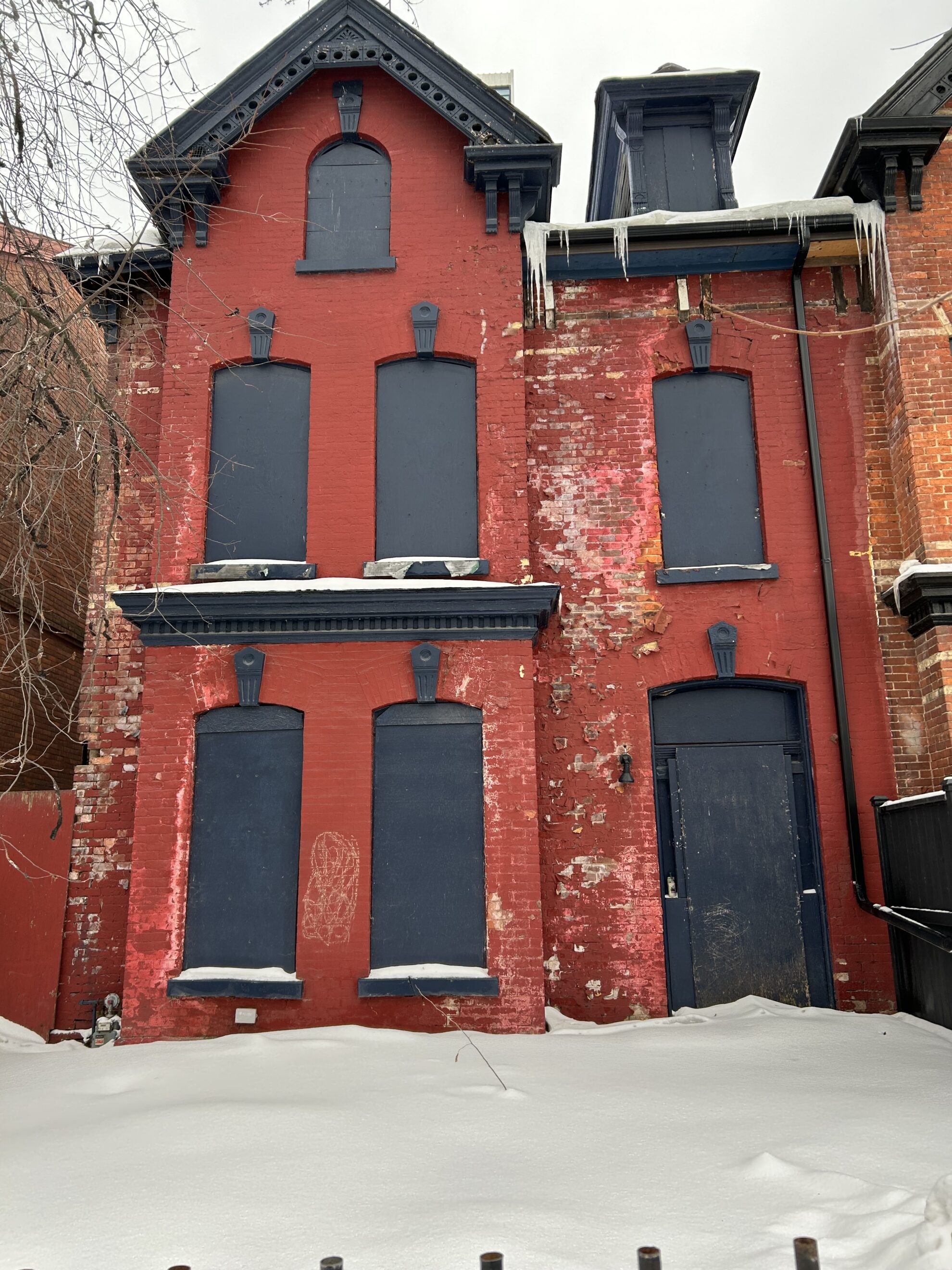
For more than a century, the house at 132 Seaton Street has stood among the many dwellings of Cabbagetown. Its windows are now boarded, and its red brickwork is weathered and exposed in places. Like many century homes in Toronto, the home will soon be demolished.
Surviving city directories do not list an occupant at 132 Seaton in 1872, and the address was still described as unoccupied in 1875. By 1879, however, Edwin Parmenter, a wool dealer, was living there.
A Globe newspaper advertisement of May 26, 1880, offers “a large flat to rent” at 132 Seaton for a mere $15 per month.
There must have been no takers as the house was listed as vacant through 1881. However, “gas inspector” George Sutherland moved into the house in 1882 and remained there for three years.
Early entries show that neighbourhood residents made their living in a wide range of trades and occupations. Names appear and disappear, occupations change, and an address is occasionally be recorded differently in another source.
From 1890 through 1905, 132 Seaton was home to Philip Dwyer, a tailor whose place of employment was given as 65 King Street West. From 1908 to 1915, Samuel J. Frame was listed at the house as a clerk with Jenkins & Hardy, chartered accountants, at 151½ Toronto Street. The 1911 census, however, described Frame as a carpenter.
In 1920, the occupant was John Quinn, a mariner. He gained some local notoriety in 1923 with a newspaper account of near tragedy when his steamer ship, the W.J. Carter, sank in a violent storm on Lake Ontario. Apparently, Quinn and eight crew members took to a storm-battered lifeboat and drifted for six hours before being rescued.
Quinn’s wife Annie, brought the home to public attention in the summer of 1928 in the following newspaper story:
“When she arose out of bed early Sunday morning (June 3) in her home at 132 Seaton Street, a woman named Annie Quinn was very badly burned when her nightrobe took fire from a heater. She was removed to hospital in critical condition.”
The next day’s Toronto Daily Star reported that despite the hospital’s best efforts, Annie Quinn died of her injuries.
In 1930, John M. Adair was listed at 132 Seaton as a “waggon washer” for the Eaton’s department store. The job title evokes a Toronto in which horse-drawn wagons were an essential part of the city’s commercial life. Adair’s work suggests the practical, physical jobs that helped keep the city moving before delivery trucks and motor vehicles dominated.
By 1931, the directory identified Nelson Foote, a millwright, as the owner of 132 Seaton. Foote remained at the address for much of the next two decades. In 1945, Edgar Alcombrac, an electrician with Canadian General Electric, was also listed there.
The address appeared twice in the newspapers during these years. A September 1934 Globe report recorded a police raid on a betting parlour. In 1951, a letter to the Toronto Daily Star came from Ernest Corby at 132 Seaton Street.
By 1960, two more working men were listed at 132: Gordon Rykeman, a labourer with the City of Toronto’s Streets Division, and George Lettington, a lather. After that, the documentary trail becomes thinner. Directories leave the address blank in 1964 and 1965.
By 1970 it was described as a rooming house, and again in 1990. The latest occupant found in the directory material is J. Phillips in 2001.
The photograph of 132 Seaton today shows the windows and door are boarded over, while the elaborate trim around the openings and the steeply peaked roof remain visible. Sections of the painted brick have worn away, exposing earlier layers beneath.
For generations, the building was simply a place where working people lived. A wool dealer, a gas inspector, a tailor, an accountant’s clerk, a carpenter, a lake boat captain, a wagon washer, a millwright, an electrician, city labourers and others passed through its rooms and its doorway.