
Beth Kaplan –
“I didn’t want to retire,” José Yanez says. “But everyone now is wearing running shoes. They retired me.”
José the shoemender never wears running shoes himself, even though at 82 he suffers from foot pain. Running shoes are bad for the planet, he points out, because they’re made of toxic chemicals rather than natural materials.
He gestures to a mat beside the door neatly lined with leather shoes and picks up a shiny brown pair. “These are my dancing shoes. That’s what I wear.”
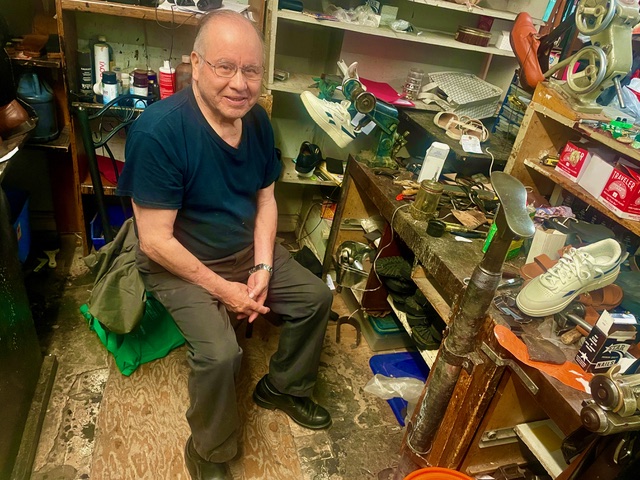
Cabbagetown has suffered a loss with the recent closing of José’s business on Carlton Street, where he sat all day behind big black machines. There he was surrounded by leather and glue – and interesting doodads, clothing and boots for sale. Customers brought their broken shoes and often stayed to chat. Now his world has shrunk.
“I like to work, to be busy,” he says, unsure what the next chapter holds.
Born in the city of Ambato in Ecuador, José speaks glowingly about his beloved mother and stepfather, whom he visited and supported all their lives. “We were very poor. We had no toys. Sometimes I went to school with no shoes. But my parents were so nice.”
When he was eleven, a teacher hit him for being late; he ran home in tears and never went back. His stepfather asked if he wanted to become a mechanic, like him.
“I want to be a shoemaker,” replied José, because a neighbour was one. He apprenticed with the neighbour for five years, learning to craft shoes by hand.
“He taught me to make everything perfect,” he says proudly. “I even made my own soccer shoes by hand, putting the spikes in one by one.”
In his late twenties, leaving a wife and four children behind temporarily, José went to Bermuda where he’d heard there were good jobs. His turned out to be dishwashing.
In 1975 he came to Canada and was offered work immediately, as a painter and then in a factory. “Six years with no papers, before becoming a landed immigrant,” he says. “It was hard. But my best idea was to come to Canada. I love Canada.”
At last he found work at a shoe repair shop on Queen Street West. When he heard about a repair business for sale on Carlton Street, he had no money and no credit rating, as most of his dealings had been in cash. But his wife was able to get a bank loan, and in 1997 he purchased the business. Even during the pandemic, when the shop had to shut down, he never defaulted on the rent.
“I worked from 7 a.m. to 7 p.m. six days a week,” he says, while also delighting in looking after some of his young grandchildren in the shop. He always enjoyed the work, although sometimes customers would bring shoes for repair and then not pick them up. The spotless bachelor apartment he shares with Liliana, his partner of 12 years, still has bags of unclaimed, unpaid-for shoes brought from the shop. Soon the couple will donate them to charity.
Closing down the business was especially painful for José because it was nearly impossible to find a home for his precious tools. Few shoe repair shops are left in Toronto.
“There used to be three or four in this area alone. Now the only one, I think, is in the Dufferin Mall; I gave him some stuff.
“I had to get rid of valuable things: a hundred-year-old sewing machine, some expensive Italian soles. Nobody wants to re-sole their shoes now. I would have had to pay to get rid of the big machines, but someone took them away for me.”
Despite this loss and his aches and pains, the Cabbagetown shoemender is still optimistic and sweet-tempered. “My family is my fortune,” he says, though none of his 11 grandchildren and two great-grandchildren has followed him into the shoe business.
José has endured several surgeries on his legs and feet. Not long ago, a doctor prescribed what he hoped would help him walk better. “Go find some grass,” the doctor ordered, “and walk barefoot.”