

Julia Frankling –
Last September a downtown condominium board filed a $2.3 million lawsuit against the Sanctuary Ministry neighbourhood drop-in centre, alleging that it has become a “free for all haven” for illegal activity.
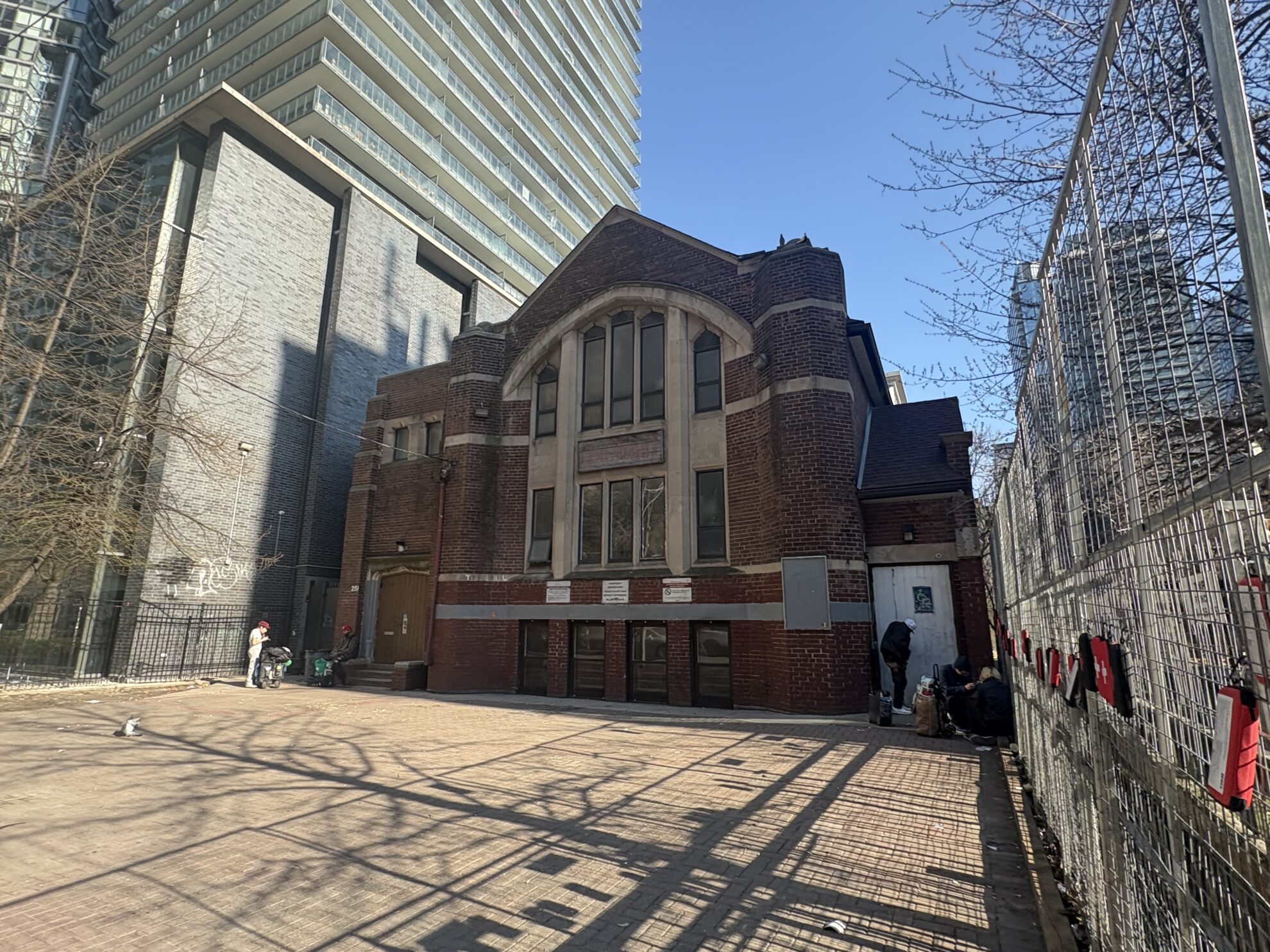
The 46-storey CASA Condo at 33 Charles Street East, which opened in 2010, is seeking damages and an injunction. The claim alleges that individuals associated with the Sanctuary church, which provides free meals and services to vulnerable populations, have trespassed, caused property damage and disturbances requiring increased police and security services. It also cites incidents of harassment, theft, drug use, noise disturbances, violence, encampments and garbage around the property.
“Sanctuary’s operations have created ongoing safety risks for residents and employees,” condo board president Peter McDonald told the National Post. “We are asking Sanctuary, together with the city and the police, to balance service delivery with basic neighbourhood safety.”
Sanctuary disputes the claims. In its statement of defence filed in February, the organization argues that the alleged harms are “insubstantial” and don’t meet the legal threshold for nuisance. It denies responsibility for the actions described and maintains they have not trespassed, been negligent or caused damage to CASA Condos.
Dustin Hanson, who’s been going to Sanctuary for 21 years, said, “That condo is claiming that the staff condone and encourage the violence and drug use, but they discourage it and it’s not allowed to be done on property, although sometimes it gets hectic.”
“Sanctuary Church was here first,” the organization states in its court filing. Sanctuary Ministries of Toronto has operated in the Yonge-Church corridor since 1992, providing community meals, housing support, harm reduction supplies, an arts program and healthcare services to the city’s unhoused and those struggling with mental health and addiction. The church says it serves 150 to 200 people through its meal program.
The church operates for limited hours during the week, and the condo’s lawsuit claims that when it’s closed people congregate outside, including in the adjacent George Hislop Park. Previous encampments beside the church were removed by the city, after the park was renovated and fencing went up.
According to Jas Baweja senior communications advisor for the City of Toronto, there are other reasons for the fencing. “Three sections of the park are fenced off for seasonal maintenance, including turf rehabilitation and repairs to the irrigation system. Staff will remove the fence once that work is complete. We don’t have a timeline on that yet.”
Some residents are concerned about safety. Condo resident Jeff Chung said, “They only fenced off the section where the encampments were. When it’s bad, it’s bad. They would take over the street and it becomes a wild zone; they caused a fire once and an axe knife fight. Women find it frightening and don’t feel safe around it.”
The fire, which was ruled a homicide by police, occurred on Boxing Day of last year, resulting in the death of Keith Appleby who was homeless and sleeping in a tent pitched outside the door of Sanctuary.
Resident Martin Cariage says “My fiancé got yelled at. During the winter it’s calmer ‘cause it’s cold outside, but when the temperature is better, more people will be around.”
Some condo dwellers have empathy for the situation. Garv Mishra, who was assaulted some years ago, said, “My boyfriend was also attacked two months ago at Bloor station, and we got a call from the cops last week that the person was arrested at Sanctuary. However I am not in favour of displacing people, or closing Sanctuary. Just because it’s not convenient doesn’t mean someone should be sued.”
Mishra adds that broader issues like housing and mental health access are key factors. “The lack of infrastructure and mental health resources is responsible for this.”
Greg Cook, an outreach team lead who has worked at Sanctuary since 2009, said the legal process has been straining staff’s time and resources, yet programming continues. “They’re supporting the community and clients the best they can, just not as robustly.”
Sanctuary’s defence notes that homelessness in Toronto more than doubled between 2021 and 2024, while housing availability and social supports have declined. It also pointed to the opioid overdose deaths and recent closures of supervised consumption sites.
Cook said these changes are already having negative effects. “Whatever supports are cut back are going to impact the community. It’ll mean more people dying, more people’s quality of life adversely impacted.”
Since the provincial government began ordering the supervised sites closed last year, to be replaced with the Ford government’s HART Hubs, Sanctuary remains one of a handful of places downtown that provide harm reduction supplies and overdose response. Staff says demand has increased and predict a further increase when the remaining sites close in June.
Christopher B., a Sanctuary regular, says “I OD’d across the street and they saved me. I wouldn’t be here if it wasn’t for them.”
“Organizations are being pressured to shut down. That doesn’t make people who are unhoused housed,” says Cook.
Hanson says, “It’s exactly what the name of the place is, it’s a sanctuary. It’s a safe place I can get some peace after being homeless for a long time living with HIV since I was 18. Sanctuary helped me get housing. One of the nurses helped me fill out my application – I wouldn’t have been able to do it myself. This place and the people who run it are kindhearted; I consider them family.”
Advocates say the lawsuit sets a precedent beyond one non-profit charity. Mel Joy, executive lead from the Toronto Drop-In Network, says “Regardless of the outcome, the measures that CASA Condos has enacted undermine the critical community services that Sanctuary and drop-in centres across the city provide. The positioning of community services and the vulnerable populations they serve as a nuisance requiring punitive action not only negatively affects service providers and service users, but contributes to a divisive discourse of who is deserving of community care and safety. It’s our collective responsibility to name and address the systemic causes of our inequity and hold decision-makers accountable for changes that will make our communities safe, healthy and inclusive for all.”
Toronto Centre City Councillor Chris Moise’s office did not respond to a request for comment before publication.
This case is still in its early stages and could take years to resolve. While no court date has been set, Sanctuary is soliciting donations to fund its defence.
Cook said he hopes a solution can be reached out of court.


1 Comment
Last year at this time, I took an alternative route home, walking along Charles Street East. I was struck by the continuing and accelerated level of disorder on the street. The visible concentration of semi-encampments, along with individuals experiencing mental health challenges and addiction, was deeply concerning. From a distance, I observed vehicles repeatedly arriving and departing, appearing to engage in exchanges with individuals on the property of Sanctuary Toronto Ministry.
This site sits immediately adjacent to residential condominiums, across the street from Toronto Heritage Housing properties, and only a short distance from the Toronto Metropolitan University campus, making the situation even more troubling, as residents and students who live on this street must tolerate this social experiment gone terribly wrong.
In response, I formally raised my concerns with Councillor Chris Moise, Mayor Olivia Chow, and MPP Kristyn Wong-Tam. I included documented images that spoke for themselves. The severity of the situation required little explanation.
Conversations with members of the local community, including students, condo owners and security staff from the nearby CASA condominium, revealed a troubling sense of resignation. There appeared to be a widespread acceptance that chronic operational issues at Sanctuary Toronto Ministry had gone unaddressed for some time.
Further concerns emerged upon reviewing the Canada Revenue Agency’s public records on the organization. Not-for-profits that are well-managed and committed to their mission typically maintain strong compliance with CRA requirements to preserve their status and funding. Sanctuary Toronto Ministry, however, showed a record of poor standing due to incomplete tax filings, yet legacy filings demonstrated fulsome donations from the government and private sector. This raised serious questions about governance and accountability.
Such deficiencies point to a broader issue of operational failure. For organizations entrusted with charitable or government funding, maintaining financial and administrative oversight is not optional, it is a fundamental fiduciary responsibility.
Most troubling is the possibility, however difficult to confront, that a charitable organization could drift away from its mission, becoming more focused on sustaining payroll than delivering meaningful impact.
As this situation continues to unfold, many will be watching closely for accountability and reform. The outcome of the ongoing class action lawsuit will be an important moment in determining whether those responsible are held to the standards the public rightly expects.