
Rodrigo Huerta Aguirre –
The stories of Downtown East’s former ‘gentlemen’s club’ have been captured in portraits and a lightbox collected as ‘Filmores Hotel Art Exhibition’. First unveiled in 2024, the exhibition opened to the public last week in Leaside’s Motorista Studio (25 Commercial Road, east of Laird Drive) for the first time since the iconic strip club closed in January.
“It’s like looking at Toronto with a magnifying glass,” photographer Jorge Posada told the bridge. After moving from Vancouver to the Garden District in the middle of the pandemic, Posada and Benjamin Samson, the show’s producer, searched for a building that represented the story of the city, something that inspired people through its transformation.
“Filmores was incredibly perfect,” Posada said.
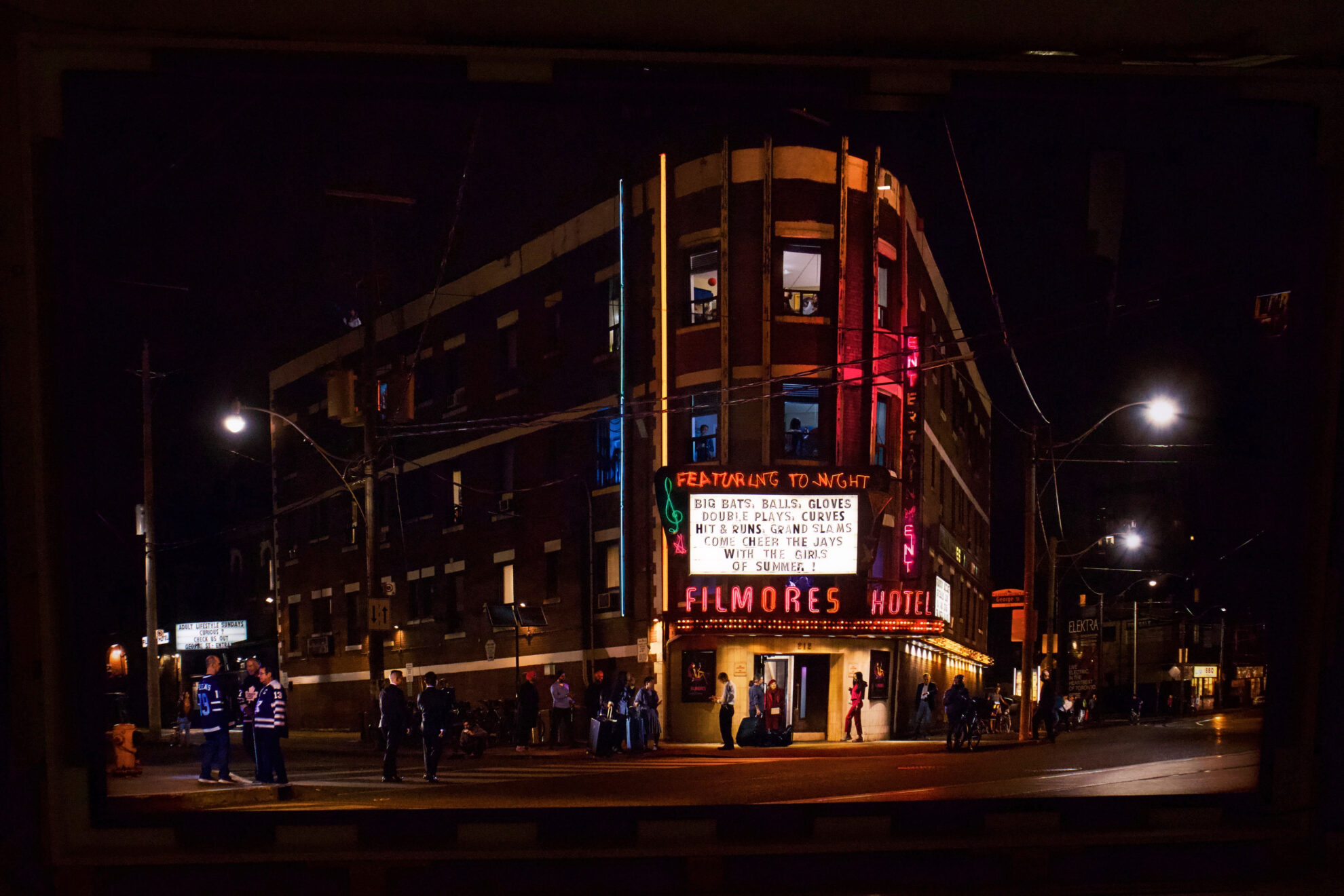
The exhibition’s central piece is a lightbox, a six-by-ten-foot photo collage framed in a metal box with LED lights, which illustrates the building’s identity with a high level of detail. Leafs fans, hotel dwellers and club patrons are just a few of the characters Posada and Samson interviewed, photographed and meticulously placed in the photo over almost four years.
“The work cannot be about any particular window. It has to have a cohesive home so that no part of the image takes over,” Samson said. “There were more stories we wanted to shoot and would have loved to create.”
As interior demolition of Filmores (212 Dundas Street East) was already scheduled to allow for a 44-storey rental tower development, Posada and Samson wasted no time meeting the project planners, who approved the art pitch and referred them to Howard Adams, owner of the Filmores Hotel.
“One minute into the presentation he was like, ‘I love it. Let’s do it,’” Posada recalls from his initial interaction with Adams. That same day, the Filmores owner took the duo on a tour from the lowest basement in the building to the rooftop and gave them full-access to the gentlemen’s club. “In Vancouver, things were never that easy […] We slowly engaged and became part of the [Filmores] community.”
After debuting in Album Studios on Geary Avenue followed by a one-month showcase at Cabbagetown’s 99 frames (527 Parliament Street), the ‘Filmores Hotel’ exhibition found a temporary home in Motorista Studio, a social club for community artists and car aficionados.
In the entry hall, 18 portraits of staff and community members important to Filmores welcomed visitors. “There was a lot of research and a lot of listening to the meaningful people that are and were part of the community to really [understand] the journey of the building,”
Full body photos also complemented the stories in the portraits, with one of three coloured backgrounds indicating whether the character was a hotel member, club staffer or Garden District resident. Glen, a community member and one of those portrayed commented in an interview that “Filmores has gone through its own transition, but it’s always been a good neighbour from my perspective.”
Inspired by Canadian visual artists Rodney Graham and Ian Wallace, the use of conceptual photography aligns with the Posada’s and Samson’s vision to prove photography as a “valid art form,” Posada explains. Photography excels at “deliver[ing] a message in an instant,” Samson says.
“High touch is very evident in this work. This is going to be relevant art for the foreseeable future,” Richard Cerezo, an event attendee and professional photographer, told the bridge during the exhibition night. “The heartbeat of a city relies on exposing the kind of scenes we see here. Art is not dead, and this is a testament to that.”
With unceasing crowd flows throughout the night – including many of the people Posada photographed – Posada and Samson expressed satisfaction with the turnout for the exhibition, which will soon relocate to their personal studio in Leslieville and become available for private showings. “We’re so fortunate that it could become real.”
The ‘Filmores Hotel’ exhibition was helped by a grant by the Canada Council for the Arts and collaboration with students from the Toronto Film School. “It takes a community to make such a piece,” Posada said.
The duo is now focused on showing the work to buyers, advisors and consultants to continue producing art and possibly touring with it overseas. In the meantime, they hope the exhibit helped visitors “remember the Toronto from before” and are on the lookout to “make more corners memorable.”